

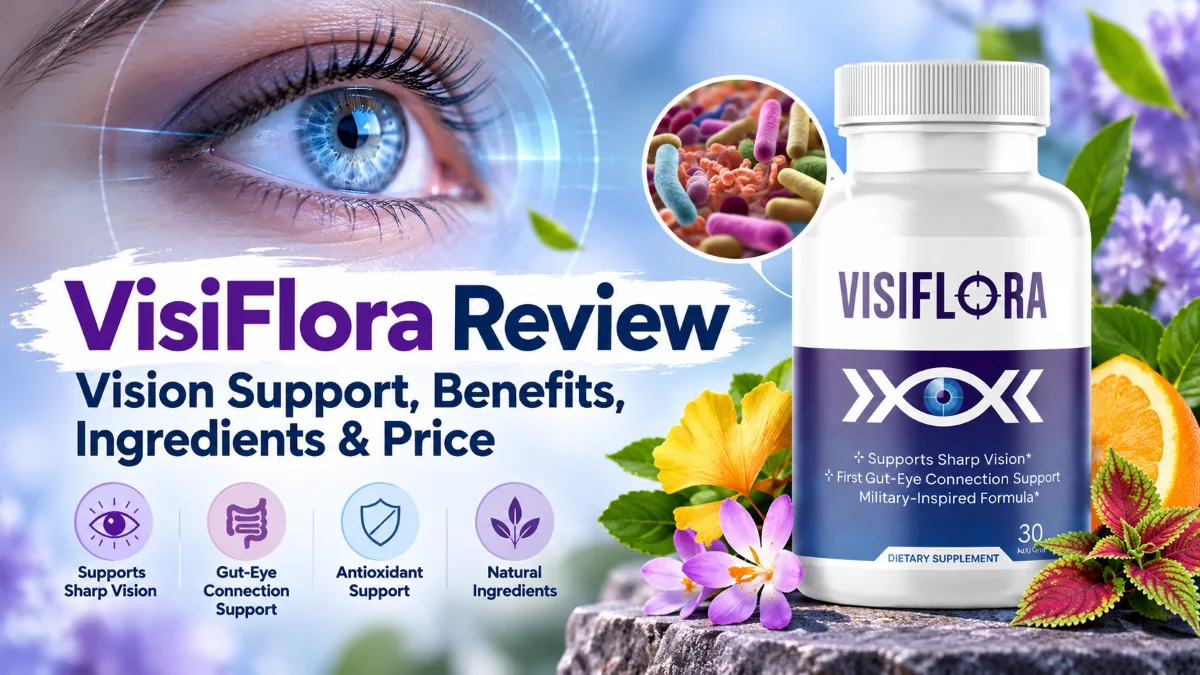
Quick Answer: VisiFlora is marketed as a once-daily, 22-ingredient dietary supplement designed to support everyday eye wellness, visual comfort, retinal nutrition, and the body’s gut-eye connection. Its advertised formula includes nutrients and plant compounds such as lutein, zeaxanthin, astaxanthin, bilberry, vitamin A, vitamin C, vitamin E, zinc, selenium, saffron, grape seed extract, quercetin, taurine, and other botanical ingredients. The brand currently promotes a one-capsule-per-day routine and a 60-day money-back guarantee. However, it is important to distinguish between evidence for individual nutrients and clinical evidence for the finished product itself.
If you’re considering VisiFlora, the biggest question is not simply whether its ingredients sound promising. The more useful question is whether the formula, dosage, price, and intended use make sense for your particular eye-health goals.
VisiFlora Review at a Glance
| Feature | Details |
| Product | VisiFlora |
| Category | Daily dietary supplement for eye wellness |
| Advertised formula | 22 ingredients |
| Suggested use | 1 capsule daily with food |
| Main nutritional focus | Carotenoids, vitamins, minerals, antioxidants and botanicals |
| Key advertised ingredients | Lutein, zeaxanthin, astaxanthin, bilberry, vitamin A, zinc, saffron and others |
| Intended audience | Adults interested in maintaining everyday visual wellness |
| Manufacturing claim | Made in the USA / U.S. facility according to brand materials |
| Guarantee | 60-day money-back guarantee according to the sales page |
| Current advertised pricing | Packages vary; current sales-page pricing should be checked before ordering |
| Availability | Click Here |
The information above is based primarily on the product’s current sales materials. Pricing and promotional claims can change, so consumers should verify the label and checkout page before purchasing.
What Is VisiFlora?
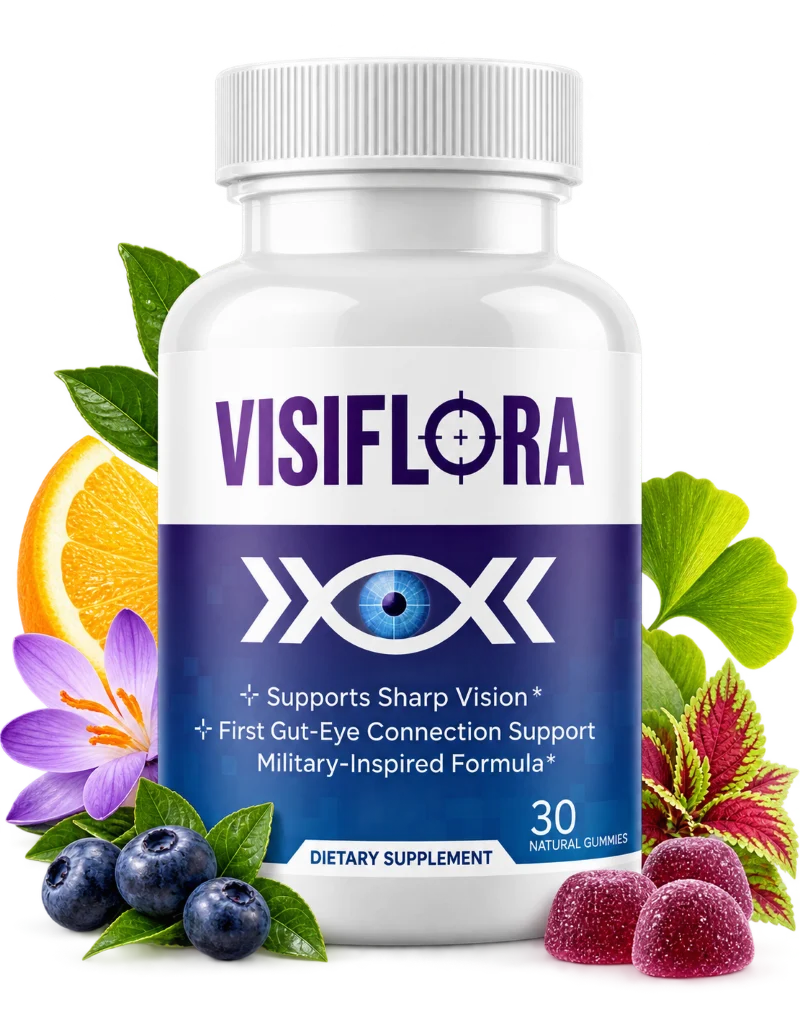
VisiFlora is a dietary supplement positioned around a broader approach to everyday eye wellness. Rather than focusing on one vitamin, the formula combines carotenoids, antioxidant compounds, vitamins, minerals, and botanical extracts.
The company describes VisiFlora as a 22-in-1 formula and highlights the connection between nutrition, gut health, and visual wellness. The idea behind this approach is that overall nutritional status and systemic health can influence the body’s ability to maintain healthy tissues, including the eyes.
That concept is interesting, but it deserves some context.
There is established scientific evidence that certain nutrients are important for eye health. Lutein and zeaxanthin, for example, are concentrated in the retina and are associated with macular pigment. Vitamin A is also essential for normal vision because retinal cells require vitamin A-related compounds for the visual cycle.
However, this does not mean that taking a multi-ingredient supplement automatically improves eyesight or reverses an eye condition. The National Eye Institute makes an important distinction: AREDS/AREDS2 supplements can slow progression of certain stages of age-related macular degeneration, but they do not prevent AMD from developing in the first place and are not a general cure for vision problems.
That distinction is important when evaluating VisiFlora.

How Does VisiFlora Work?
The proposed approach behind VisiFlora has several parts.
First, the formula supplies carotenoids such as lutein and zeaxanthin. These compounds naturally occur in the retina and lens and can help absorb certain high-energy wavelengths of light. The National Eye Institute notes that lutein and zeaxanthin are found in the retina and lens, where they may function as antioxidants and help absorb damaging blue and ultraviolet light.
Second, the formula includes antioxidant ingredients. Oxidative stress is one of the biological processes researchers investigate in relation to aging and tissue health. Antioxidants are therefore frequently included in nutritional formulas designed for eye wellness.
Third, VisiFlora incorporates botanical compounds and nutrients intended to provide broader nutritional support.
Finally, the company emphasizes a “gut-eye” concept. This is an emerging area of research, but consumers should avoid interpreting the concept as proof that repairing gut health will automatically restore eyesight.
In other words, VisiFlora’s overall concept is nutritionally plausible, but the evidence for individual ingredients should not be confused with clinical evidence proving that the complete finished formula produces a particular visual outcome.
VisiFlora Ingredients
One of the most important parts of any VisiFlora review is the ingredient list.
Current product pages describe a 22-ingredient blend. The published ingredient lists across the brand’s sales pages include the following compounds:
- Lutein
- Zeaxanthin
- Astaxanthin
- Bilberry extract
- Vitamin A
- Vitamin C
- Vitamin E
- Zinc
- Selenium
- Copper
- Lycopene
- Saffron extract
- Grape seed extract
- Quercetin
- Rutin
- Taurine
- Alpha-lipoic acid
- Ginkgo biloba
- Eyebright
- Rhodiola
- Ashwagandha
- Chromium
Because supplement formulations and labeling can change, consumers should check the current Supplement Facts panel before ordering rather than relying exclusively on a marketing page. One current product page lists these 22 ingredients explicitly.
Lutein and Zeaxanthin
Lutein and zeaxanthin are probably the most familiar eye-focused ingredients in the formula.
These carotenoids are particularly relevant because they are naturally present in the retina. They are also central to the AREDS2 research program.
The AREDS2 trial investigated 10 mg lutein plus 2 mg zeaxanthin in people at risk for advanced AMD. The overall primary analysis did not show a statistically significant additional reduction in advanced AMD when these nutrients were simply added to the original AREDS formulation. However, subsequent analyses found important advantages when lutein and zeaxanthin replaced beta-carotene, particularly among people with low dietary intake of these carotenoids.
This is one reason it is reasonable to pay attention to the amounts of these nutrients, not merely whether they appear on a label.
Astaxanthin
Astaxanthin is another carotenoid with antioxidant properties. It has attracted attention in research involving oxidative stress and visual function.
However, evidence surrounding astaxanthin is not equivalent to the evidence behind the AREDS2 formula. It should therefore be viewed as a nutritional component rather than proof that VisiFlora can treat an eye disorder.
Bilberry
Bilberry is a fruit extract commonly included in formulas marketed for circulation, antioxidant protection, and visual wellness.
Although bilberry has a long history of interest in eye-health research, evidence for supplements containing bilberry is mixed and should not be exaggerated.
Vitamin A
Vitamin A is an essential nutrient for normal vision. The retina depends on vitamin A-related compounds as part of the visual process.
But more is not necessarily better. High intake of certain forms of vitamin A can be harmful, which is why consumers should look at the actual dosage rather than assuming that a vitamin’s presence makes a product safer or more effective.
Vitamins C and E
Vitamins C and E are antioxidant nutrients and are included in established AREDS formulations at specific doses.
That said, VisiFlora should not automatically be considered an AREDS2 substitute merely because some of its ingredients overlap with AREDS2.
The scientifically studied AREDS2 formula has a specific composition and specific doses, including vitamin C, vitamin E, lutein, zeaxanthin, zinc, and copper.
Zinc and Selenium
Zinc plays several biological roles, while selenium contributes to antioxidant defense systems.
Both nutrients can be useful when dietary intake is inadequate, but supplementation should remain within appropriate levels.
Saffron, Ginkgo, Quercetin and Other Botanicals
The remaining ingredients give the formula a broader antioxidant and botanical profile.
Some have interesting preliminary research behind them, but preliminary evidence should not be treated as proof of clinical effectiveness.
This is a common problem with supplement advertising: an ingredient may have a plausible mechanism, yet the finished product may never have undergone a large randomized clinical trial.
That is why a balanced VisiFlora review should look at the entire evidence picture.

Potential VisiFlora Benefits
The manufacturer promotes the product around several areas of eye wellness.
Potential benefits associated with the formula include:
1. Nutritional support for the retina
The retina requires a constant supply of nutrients because it contains highly specialized light-sensitive cells. Carotenoids and antioxidant nutrients are commonly studied in relation to retinal health.
2. Support for macular wellness
Lutein and zeaxanthin are particularly relevant to the macula because these carotenoids are concentrated in this region of the retina.
3. Everyday visual comfort
People who spend many hours looking at phones, computers, or other digital displays often become interested in nutritional approaches to eye wellness. A supplement may fit into a broader routine, although screen-related discomfort can also have many causes.
4. Antioxidant support
The formula includes multiple antioxidant-related nutrients and plant compounds.
5. Convenient daily routine
The manufacturer recommends one capsule daily with food, which makes the routine relatively simple.
It is important, however, to keep expectations realistic. A supplement should not be expected to eliminate the need for glasses, contact lenses, regular eye examinations, or treatment for diagnosed eye disease.
What Does Science Say About Eye Supplements?
This is where the review becomes more important than the marketing.
There is strong evidence for specific nutritional formulations in specific circumstances.
The National Eye Institute reports that AREDS and AREDS2 supplements can reduce the risk of progression from intermediate to advanced AMD by about 25 percent in appropriate patients. These supplements are not intended for everyone with normal vision.
The American Academy of Ophthalmology similarly explains that AREDS2 may benefit people with certain forms and stages of AMD, but nutritional supplements are not a cure and do not restore lost vision.
The important takeaway is:
Evidence for a nutrient is not automatically evidence for a commercial supplement containing that nutrient.
For VisiFlora, some ingredients have meaningful scientific backgrounds, but that does not establish that the entire 22-ingredient formula has the same clinical evidence as AREDS2.
That distinction should be front and center for anyone considering a purchase.
VisiFlora Price: How Much Does It Cost?
Pricing is one area where buyers should be especially careful because promotional offers can change.
The current sales page lists several package options. At the time of our research, the displayed offers included approximately:
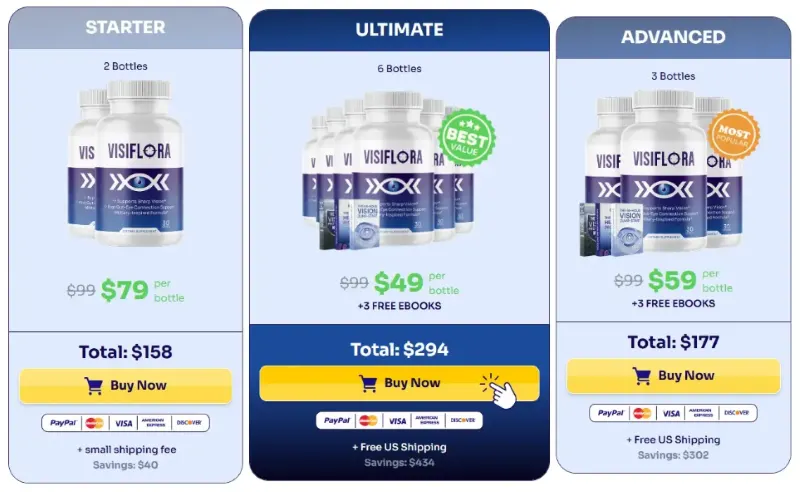
- 2 bottles: $79 per bottle, $158 subtotal
- 3 bottles: $59 per bottle, $177 total
- 6 bottles: $49 per bottle, $294 total
The sales page also states that the larger packages may include free U.S. shipping and bonus materials. However, promotional pricing can change, so the checkout page should be considered the final source for the amount charged.
A 60-day money-back guarantee is also advertised by the brand.
VisiFlora Pros and Cons
| Pros | Cons |
| Broad 22-ingredient formula | The finished formula does not appear to have the same large clinical-trial evidence as AREDS2 |
| Includes lutein and zeaxanthin | Individual ingredient evidence cannot prove product-level effectiveness |
| Once-daily routine | Exact ingredient doses should be checked on the current label |
| Includes several antioxidant nutrients | Not intended to replace medical eye care |
| Convenient capsule format | Results can vary between individuals |
| 60-day money-back guarantee advertised | Promotional prices may change |
| Brand states it is manufactured in the USA | Multiple similarly named websites make it important to verify the seller |
Is VisiFlora Legit?
So, Is VisiFlora legit?
There are two separate questions here.
The first is whether VisiFlora is presented as a real dietary supplement with an ingredient formula, ordering process, and refund policy. The current sales materials provide those details, including a listed 22-ingredient formula, suggested daily use, pricing packages, and a 60-day guarantee.
The second question is whether it is clinically proven to produce dramatic improvements in eyesight.
That answer is more cautious.
I would not describe VisiFlora as a clinically proven treatment for vision loss or eye disease. The product itself is marketed as a dietary supplement, and its website states that it is not intended to diagnose, treat, cure, or prevent disease.
Therefore, calling it a “scam” simply because it is a supplement would be unfair, but calling it a proven treatment would also go beyond the available evidence.
A reasonable conclusion is that it is a nutritional eye-health product containing several ingredients with scientific relevance, but consumers should keep their expectations realistic.
A real U.S. Case Study
A 48-Year-Old Office Worker in California
Consider a U.S. consumer named Mark, age 48, who spends roughly eight hours a day working on a computer.
Mark notices that his eyes often feel tired by late afternoon. He is not experiencing sudden vision loss, severe pain, flashes, or other emergency symptoms. He visits an optometrist and receives a routine eye examination.
His doctor does not identify an urgent eye disease but recommends practical habits such as regular screen breaks, adequate sleep, proper lighting, and a nutrient-rich diet.
Mark is also interested in adding a nutritional supplement to his routine.
After reviewing the ingredient label, he considers VisiFlora because it contains lutein, zeaxanthin, antioxidant nutrients, and several botanical ingredients.
After several weeks, Mark reports that he feels more conscious about his overall eye-health routine. But because this is a hypothetical case, we cannot claim that the supplement caused a measurable improvement in his vision.
The important lesson is that a supplement should complement—not replace—basic eye-care habits and professional examinations.
A real-world consumer should also discuss supplements with a healthcare professional if they have an eye condition, take prescription medications, use blood thinners, are pregnant or breastfeeding, or are preparing for surgery.
Where Should You Buy VisiFlora?
Consumers should be careful when searching online because several websites using very similar VisiFlora-related domain names appear in search results.
The safest approach is to verify that the page you are purchasing from matches the brand’s current official sales information, refund policy, contact information, product labeling, and checkout terms.
The current brand page states that the product is sold directly through its official website and is not sold through major retail stores or marketplaces.
For the current offer and ordering information, check the brand’s sales page:
Before entering payment information, confirm the domain carefully. This is especially important because search results contain multiple look-alike domains.
Order VisiFlora Today – Support Your Vision & Eye Health
Who Might Consider VisiFlora?
VisiFlora may appeal to adults who:
- Want to add nutritional support to an overall eye-health routine
- Prefer a once-daily capsule
- Are interested in carotenoids such as lutein and zeaxanthin
- Spend significant time using digital screens
- Want a broader antioxidant and botanical formula
- Are looking for a supplement rather than prescription treatment
However, people with diagnosed eye disease should speak with their ophthalmologist before changing or adding supplements.
How to Support Eye Health Naturally
Even if you decide to try VisiFlora, the foundation of good eye care should remain broader than a capsule.
The American Academy of Ophthalmology recommends focusing on a varied, nutrient-rich diet. Foods containing vitamin C, vitamin E, zinc, lutein, and zeaxanthin can all contribute to a healthy diet for the eyes. Dark leafy greens and colorful fruits and vegetables are particularly useful choices.
A practical eye-health routine can include:
- Eating leafy green vegetables regularly
- Including colorful fruits and vegetables
- Eating fish as part of a balanced diet when appropriate
- Wearing appropriate UV protection outdoors
- Taking regular breaks from prolonged screen use
- Getting regular eye examinations
- Controlling blood pressure and blood sugar
- Avoiding smoking
- Getting sufficient sleep
These habits are more important than relying on any single supplement.
Final VisiFlora Review: Is It Worth Considering?
After looking at the formula, advertised benefits, price, and available science, VisiFlora appears to be a broad nutritional eye-wellness supplement rather than a medical treatment.
Its strongest point is the inclusion of familiar eye-health nutrients such as lutein and zeaxanthin alongside vitamins, minerals, antioxidants, and botanical ingredients. The once-daily format may also make it easy to incorporate into a routine.
The biggest limitation is the evidence gap.
There is meaningful clinical research behind specific nutrients and established formulas such as AREDS2. But that evidence should not automatically be transferred to every commercial supplement containing some of the same ingredients.
For someone with normal vision who simply wants to improve their overall nutrition, a supplement like VisiFlora may be something to discuss with a healthcare professional. For someone with an established eye condition, however, professional guidance should come first.
My overall assessment is cautiously positive for nutritional support, but not as a replacement for evidence-based eye care.
The smartest approach is to look at the Supplement Facts panel, compare the actual doses with your nutritional needs, check the current price and refund policy, and consider whether the product fits your specific goals.
Most importantly, don’t wait for a supplement to address symptoms that could represent an eye emergency.
Frequently Asked Questions About VisiFlora
1. What is VisiFlora?
VisiFlora is a dietary supplement marketed for everyday eye wellness. The current product materials describe a 22-ingredient formula containing carotenoids, vitamins, minerals, antioxidants, and botanical compounds.
2. What are the main VisiFlora benefits?
The product is marketed around retinal and macular nutritional support, antioxidant protection, visual comfort, and general eye wellness. These claims should not be interpreted as proof that the supplement can treat an eye disease.
3. How do you take VisiFlora?
The current product information recommends one capsule daily with food. Always follow the directions printed on the product you receive because formulations and serving instructions can change.
4. Does VisiFlora contain lutein and zeaxanthin?
Yes. Lutein and zeaxanthin are included in the ingredient information published by the brand. These carotenoids are also among the best-studied nutritional compounds in the context of AMD and retinal health.
5. Can VisiFlora improve eyesight?
It would be inappropriate to promise that it can restore lost eyesight or correct refractive errors. A nutritional supplement cannot replace prescription glasses, contact lenses, surgery, or medical treatment when those are needed.
6. Is VisiFlora FDA approved?
The brand states that the product is manufactured in an FDA-registered facility. That should not be confused with FDA approval of the supplement itself. Dietary supplements are not generally “FDA approved” in the same way prescription drugs are approved before marketing.
Scientific & Reference Sources
The following resources are useful for readers who want to research eye-health supplements beyond product marketing:
- National Eye Institute (NEI) — AREDS/AREDS2 clinical trials and frequently asked questions.
- American Academy of Ophthalmology (AAO) — Nutrition, eye health, and AREDS2 guidance.
- PubMed / JAMA — AREDS2 randomized clinical trial research on lutein, zeaxanthin and omega-3 fatty acids.
- NCCIH — Evidence review of dietary supplements for eye conditions.
- VisiFlora product information — Current ingredient, pricing, usage and guarantee information.
Bottom Line
VisiFlora is best viewed as a nutritional eye-wellness supplement, not a cure for vision problems. Its ingredient profile contains several nutrients that have legitimate scientific relevance to eye health, particularly lutein and zeaxanthin. However, the evidence supporting those individual nutrients should not be mistaken for proof that the complete VisiFlora formula treats or prevents eye disease.
If you’re considering it, verify the current label, price, seller, and refund policy, and speak with an eye-care professional if you have an existing eye condition or take medications.
Disclaimer: This article is for informational purposes only and does not constitute medical advice. VisiFlora is a dietary supplement, not a medicine, and individual results may vary. Always check the product label and consult a qualified healthcare professional before using any supplement, especially if you have a medical condition, take medication, or are pregnant or breastfeeding.
Author


Your Health Rights is a U.S.-based health and wellness platform dedicated to empowering readers with clear, research-backed content across Men’s Health, Women’s Health, Weight Loss, Health Supplements, and Immunity & General Wellness.