






MetaGlucent is a dietary supplement that is used to help promote metabolic health and healthy glucose metabolism. While this supplement could be a useful addition to your diet based on its ingredients, claims, safety considerations, and price point, it is not a proven treatment for diabetes. Therefore, if you are currently monitoring your blood sugar levels or taking drugs to lower glucose levels in the body, you should consult a healthcare professional before using.
In this MetaGlucent review, I’ll take an impartial look at what this supplement can offer you, realistic expectations about how effective the ingredients may be, who should avoid using this supplement, and whether it would make sense to try this supplement for 30 days. I will not be trying to sell this supplement to you but help you to decide whether this would fit into your own metabolic health routine.
What Is MetaGlucent?
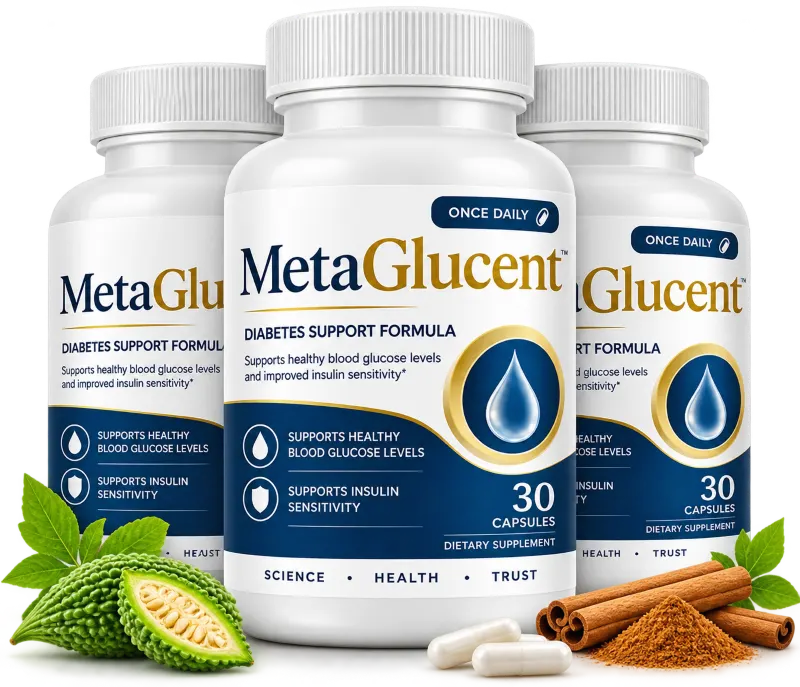
MetaGlucent is sold as a dietary supplement meant to support healthy glucose metabolism and everyday metabolic wellness. According to the official website, the capsule is made in the USA, produced in a GMP-certified, FDA-registered facility, and taken once a day. The brand positions it for adults, with a particular nod to women over 40 who care about metabolism, appetite, and gut comfort.
Two things are worth saying plainly before we go further.
- A supplement is not a drug. MetaGlucent is not intended to diagnose, treat, cure, or prevent any disease, and the site itself says it should not replace prescribed medication.
- “FDA-registered facility” is not the same as “FDA approved.” The FDA does not approve dietary supplements before they are sold. The website uses both phrases in different places, so treat the stronger wording with caution.
That kind of honesty matters, because the supplement aisle is full of big promises. A good MetaGlucent review should separate what the label says from what the marketing implies.
Why So Many Americans Are Looking for Blood Sugar Support
The interest is not random. The CDC’s National Diabetes Statistics Report estimates that around 115 million US adults have prediabetes, and about 28.8 million adults have diagnosed diabetes, with roughly 11 million more living with diabetes that has not been diagnosed. Many people with elevated blood sugar levels do not know it, which is exactly why checkups, a blood sugar monitor at home when a doctor recommends one, and lifestyle changes matter so much.
When numbers like these are floating around, it is natural that people start Googling supplements that claim to support healthy glucose. That is the audience MetaGlucent is speaking to. It is also why we want to be careful here: someone managing glucose or taking medication has more at stake than someone buying a multivitamin.
MetaGlucent Ingredients: What Is Actually in the Capsule?
According to the product page, the formula includes the following. We have kept the descriptions grounded in what reputable health sources say, not in sales language.
- Berberine HCl: A plant compound studied for its possible role in glucose-related processes. Evidence is mixed, and berberine can interact with medications, especially glucose-lowering ones. It can also upset the stomach in some people.
- Gymnema sylvestre: A climbing plant used in traditional herbal practice. Researchers have looked at it for glucose-related effects, but high-quality human data is still limited.
- Bitter melon: A fruit used in cooking and folk remedies. Early findings are interesting, yet the evidence is not strong enough to call it a reliable tool for blood sugar.
- Cinnamon bark: Studied in many forms, with inconsistent results. A Cochrane review found the evidence insufficient to support cinnamon as a diabetes treatment.
- Chromium: A trace mineral involved in normal macronutrient metabolism. The NIH Office of Dietary Supplements notes that research on chromium and glucose control has been inconsistent, and that it may interact with diabetes medicines.
- Turmeric rhizome: Valued for its antioxidant and anti-inflammatory compounds, though it is not a proven glucose tool.
- Vitamin C, vitamin D, and magnesium: Essential nutrients that support normal body function, including normal metabolic function. Having them in the capsule does not automatically translate into better glucose control.
One more detail: the site describes a proprietary blend of thirteen plant ingredients totaling 528 mg, without listing the amount of each one. That is a transparency gap. When doses are hidden, it is hard to compare MetaGlucent to the amounts used in studies. If you decide to try it, look closely at the current supplement facts panel on the bottle, because the website text and the label can differ.

How MetaGlucent Is Meant to Work
The idea behind MetaGlucent is simple. Your body turns carbohydrates into glucose, and hormones such as insulin help move that glucose from your bloodstream into cells. The brand’s pitch is that a combination of botanicals and minerals can support that normal process while you eat well, move more, and sleep better.
Here is the honest caveat. Research on individual ingredients does not prove that the finished capsule works. A study on berberine alone, for example, says little about a 528 mg blend where berberine’s share is unknown. The website admits this in its own wording, saying that ingredient research does not establish that MetaGlucent itself is effective. We appreciate that candor, and you should keep it in mind when you read big claims anywhere else.
In plain terms, MetaGlucent is best viewed as a possible supporting player for metabolic health and a healthy metabolism, not as the main act. Food choices, activity, sleep, stress, and medical care carry far more weight for healthy glucose levels than any capsule.
What a 30-Day Trial Realistically Looks Like
Thirty days sounds like a neat test period, but it is short. Most people will not see a meaningful change in lab markers such as A1C in a month, because A1C reflects roughly three months of average glucose. So instead of asking “will this fix my numbers,” ask “can I run a clean, safe experiment?”
Here is a sensible way to structure it.
- Before you start (days 0 to 3): Talk with your doctor or pharmacist, especially if you take any prescription drugs. Bring the ingredient list. Ask whether berberine or chromium could interact with your medicines.
- Set a baseline: If your doctor already has you tracking glucose, note your usual readings, meals, and sleep. If you do not use a blood sugar monitor, do not start guessing with one on your own. Ask what is appropriate for you.
- Change one thing at a time: If you begin MetaGlucent while also overhauling your diet and starting a new workout plan, you will never know what did what. Keep other habits steady for the first two weeks if you can.
- Take it as directed: The label suggests one capsule daily. Do not take extra hoping for faster results.
- Watch for side effects (weeks 1 to 2): Stomach upset, loose stools, or dizziness are reasons to pause and call a professional.
- Review at day 30: Compare notes with your doctor. Did anything change in how you feel, how you eat, or your logged readings? Was it easy to stick with? Is it worth the cost?
If you have someone on a continuous glucose monitoring system, such as a person already prescribed one, any changes in the data should be interpreted with their care team, not with a supplement label.
Case Study: How a US Adult Might Evaluate MetaGlucent
Meet “Dana,” 46, a school administrator in Columbus, Ohio. At her annual physical, Dana’s doctor tells her that her fasting glucose is slightly above the typical range and recommends lifestyle changes plus a follow-up in three months. Dana is not on any medication. She is curious about MetaGlucent after seeing it online, but she does not want to waste money or risk something unsafe.
What Dana does well:
- She brings the MetaGlucent ingredient list to her pharmacist, who points out that berberine and chromium can interact with glucose-lowering drugs. Since Dana takes none, the pharmacist says a short trial is reasonable, with a reminder to stop and call if she feels unwell.
- She keeps a simple log of meals, walks, and sleep for two weeks before starting, so she has something to compare to.
- She adds a 20-minute walk after dinner at the same time as she starts the capsule, and she is honest with herself that the walk, not the capsule, may be doing most of the work.
- She skips buying the six-bottle pack and sticks with the smallest option, because a one-month experiment does not need a six-month supply.
What the case study teaches:
- A trial is about information, not miracle results. After 30 days, Dana can say whether the capsule was easy to take and tolerated well. She cannot say it changed her glucose.
- Her follow-up lab work at the three-month mark, interpreted by her doctor, is the real measure.
- The healthiest part of her plan is the part that costs nothing: movement, sleep, and food quality.
That is the mindset we recommend to any US reader considering MetaGlucent. Treat it as an optional add-on, keep your clinician in the loop, and let the numbers, not the marketing, guide your next step.
MetaGlucent Reviews: What Are Real Customers Saying?
Here is where we have to be careful and honest. The three testimonials on the official site (from customers listed in Texas, Arizona, and Florida) are labeled “Advertised as a Purchase,” and each includes a disclaimer that the personal impression does not prove effectiveness.
When we looked for independent MetaGlucent Reviews elsewhere, we found very little. The only third-party listing we located was a Trustpilot page with a single review, and it sits under a different web address than the main website. Trustpilot also notes that the company has not recently invited customers to leave reviews, so the rating may not be representative. We found no meaningful discussion on forums or video platforms.
What does that mean for you?
- The product appears to be new or low-volume, so real-world feedback is thin.
- You should not rely on star ratings or testimonials as proof of results.
- Any website that promises dramatic personal results from MetaGlucent without evidence deserves skepticism.
We will update this page if credible, verified customer feedback becomes available.
Buy MetaGlucent for Healthy Glucose
MetaGlucent Pros and Cons
| Pros | Cons | |
| Convenience | One capsule a day fits easily into a routine | Needs consistency over weeks, and a month is short to judge |
| Formula | Combines berberine, gymnema, bitter melon, cinnamon, chromium, magnesium, and vitamins C and D | Proprietary blend of 13 plants (528 mg) does not list individual amounts |
| Transparency | Site openly says results are not guaranteed, and it is not a treatment | The “FDA Approved” badge is misleading, since supplements are not FDA approved |
| Safety info | Clear “who should not use it” section, including medication users | Berberine and chromium may interact with glucose-lowering medicines |
| Value | 60-day money-back guarantee listed on the site | Regular price of $179 per bottle versus a promotional $49 looks like marketing pricing |
| Evidence | Ingredients have been studied individually | No published clinical trials on the complete MetaGlucent formula that we could find |
| Reviews | Easy to read the full ingredient list before buying | Very little independent customer feedback available |
MetaGlucent vs Other Options
How does it stack up against other ways people try to support metabolic health? Here is a simple comparison.
| Option | What it is | Typical strengths | Typical limits |
| MetaGlucent | Multi-ingredient capsule with botanicals, minerals, and vitamins | Convenient, all-in-one, once daily | Undisclosed blend amounts, limited formula-level evidence |
| Single-ingredient berberine | One botanical in a standalone capsule | Dose is clear, easier to compare to studies | Same medication-interaction concerns, GI side effects possible |
| Multivitamin with chromium and magnesium | Basic nutrition insurance | Inexpensive, widely available | Not targeted at glucose, small doses |
| Lifestyle only (food, walking, sleep) | No supplement | Strongest evidence base, low cost, many benefits | Takes consistency and time |
| Doctor-guided care | Medical advice, labs, and prescriptions if needed | Personalized and monitored | Requires appointments and follow-up |
Our take: if you are comparing MetaGlucent to a plain berberine product, the main difference is the all-in-one convenience versus clearer dosing. If you are comparing it to lifestyle changes, there is no contest on evidence. Lifestyle wins, and the two are not mutually exclusive.
Get MetaGlucent for Daily Metabolic Support
Safety, Side Effects, and Who Should Skip It
A responsible MetaGlucent review has to talk about risk. The brand’s own page lists groups who should check with a professional first. We agree, and we would add some context.
Talk to a doctor or pharmacist before using MetaGlucent if you:
- Take insulin, metformin, or any medicine that lowers blood sugar. Combining them with glucose-active ingredients could raise the risk of low blood sugar, which can cause shakiness, sweating, confusion, and in serious cases, more.
- Take any other prescription or over-the-counter medication. Berberine in particular is known for interacting with some drugs.
- Have liver problems or another chronic health condition.
- Are pregnant, breastfeeding, or planning a pregnancy.
- Are under 18.
- Have allergies to any listed ingredient.
Possible side effects with ingredients like these can include digestive discomfort, gas, loose stools, or constipation. High doses of supplemental magnesium can also loosen stools. Some cinnamon products contain coumarin, which may matter for people with liver concerns.
Stop and seek care if you feel faint, very shaky, unusually sweaty, or notice symptoms that worry you. Do not stop or change prescribed medication because of a supplement.
Who May Consider MetaGlucent?
Based on the product’s marketing, MetaGlucent is aimed at adults interested in general metabolic wellness and nutritional support.
It may be of interest to people who:
- Prefer a once-daily supplement format.
- Want to review a combination of botanical ingredients and nutrients.
- Are already working on balanced eating and regular physical activity.
- Want to understand the ingredients in a metabolic wellness product before purchasing.
- Are comfortable discussing supplements with a healthcare professional.
However, being interested in metabolic wellness does not automatically mean someone needs a supplement. People with normal glucose levels may not benefit from adding a complex formula, especially if they already get adequate nutrients through their diet.
Order MetaGlucent for Blood Sugar Support
Who Should Be Careful Before Using MetaGlucent?
Although the product is marketed as a daily supplement, its ingredients deserve careful consideration. Natural ingredients can still cause side effects or interact with medicines.
Speak with a qualified healthcare professional before using MetaGlucent if you:
- Have been diagnosed with type 1 or type 2 diabetes.
- Have prediabetes or a history of low blood sugar.
- Take insulin or prescription medicines that affect glucose levels.
- Take medication for blood pressure, cholesterol, or another ongoing condition.
- Have liver or kidney problems.
- Are pregnant, breastfeeding, or planning pregnancy.
- Have a known allergy or sensitivity to any listed ingredient.
Berberine is particularly important to discuss with a healthcare professional because it may interact with medications. NCCIH also advises against its use during pregnancy and breastfeeding.
MetaGlucent Pricing and Available Packages
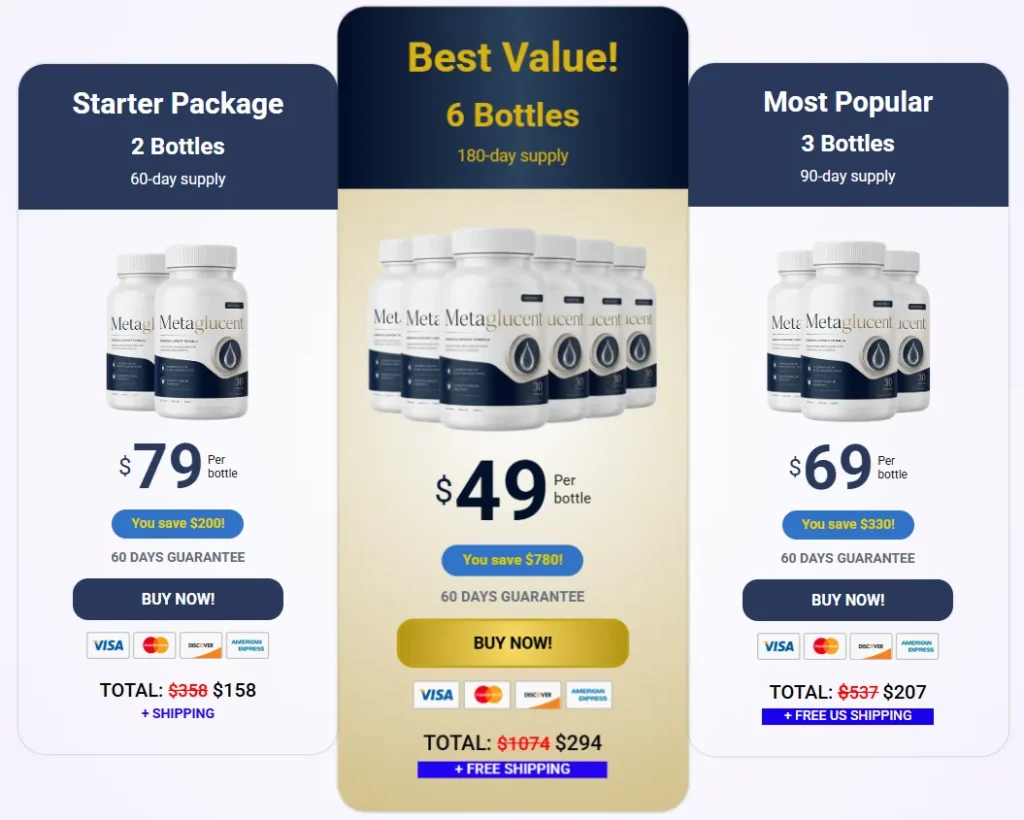
MetaGlucent is available in three package options, allowing customers to choose according to their budget and preferred supply duration. The product website displays different per-bottle prices depending on the package selected.
1. Starter Package – 2 Bottles
- Quantity: 2 bottles
- Supply: 60 days
- Price per bottle: $79
- Total price: $158
- Regular price: $358
- Advertised savings: $200
- Shipping: Additional shipping charges apply
This package is suitable for customers who want to begin with a two-bottle supply without committing to a larger order. It provides a 60-day supply based on the package information.
2. Best Value Package – 6 Bottles
- Quantity: 6 bottles
- Supply: 180 days
- Price per bottle: $49
- Total price: $294
- Regular price: $1,074
- Advertised savings: $780
- Shipping: Free US shipping
The six-bottle package is presented as the best-value option, offering the lowest advertised price per bottle. It may appeal to customers who prefer ordering a longer supply at once.
3. Most Popular Package – 3 Bottles
- Quantity: 3 bottles
- Supply: 90 days
- Price per bottle: $69
- Total price: $207
- Regular price: $537
- Advertised savings: $330
- Shipping: Free US shipping
The three-bottle package provides a 90-day supply and sits between the starter and best-value options. It may suit customers looking for a middle-ground package.
All three packages display a 60-day guarantee on the sales page. Before ordering, review the current guarantee terms, including return eligibility, deadlines, and any applicable shipping costs.
Which MetaGlucent Package Should You Choose?
The two-bottle package has the lowest initial total, while the three-bottle option offers a 90-day supply with free US shipping. The six-bottle package has the lowest displayed price per bottle and the largest advertised savings.
Choose based on your budget and requirements rather than assuming that a larger package will produce better health results. These are promotional prices shown in the supplied pricing information and may change. Confirm the final amount and shipping details at checkout before completing your order.
Is MetaGlucent Worth Trying for 30 Days? Our Verdict
Here is where we land, in plain language.
It might be worth a cautious trial if:
- You are a healthy adult not taking glucose-lowering medication.
- You have cleared it with a doctor or pharmacist.
- You see it as a small add-on to better habits, not a shortcut.
- You are comfortable with the price and the refund policy.
It is probably not for you if:
- You take diabetes medication or other drugs that could interact.
- You are pregnant, nursing, or under 18.
- You are hoping a capsule will replace diet, exercise, or medical care.
- You want strong clinical proof for the finished formula, because that does not exist yet.
So, is MetaGlucent worth trying for 30 days? For the right person, with medical guidance and sensible expectations, it is a low-effort experiment. For everyone else, your best “supplement” is still a steady routine of good food, movement, rest, and regular checkups.
Frequently Asked Questions About MetaGlucent
What is MetaGlucent?
MetaGlucent is a once-daily dietary supplement sold online to support healthy glucose metabolism. The capsule combines berberine, gymnema, bitter melon, cinnamon, chromium, magnesium, and vitamins C and D. It is a supplement, not a medicine, and it is not meant to treat diabetes.
Does MetaGlucent really work?
Nobody can say yet. Some of its ingredients have been studied, with mixed results, but we found no published trial on the finished formula. Your own doctor and lab results are a better judge than any ad or testimonial.
Is MetaGlucent legit or a scam?
We can’t confirm it either way. In its favor: a clear ingredient list, a 60-day refund promise, and honest disclaimers. Against it: almost no independent customer reviews, and an “FDA Approved” badge that doesn’t fit a supplement. Buy only from the official site, and only if you’re comfortable with the refund terms.
Is MetaGlucent safe?
It depends on your health and your medications. Ingredients like these are common in supplements, but berberine and chromium can interact with diabetes medicines. Talk to a doctor first, or skip it, if you are pregnant, nursing, under 18, or taking any prescription.
What are the side effects of MetaGlucent?
Mostly stomach trouble: gas, loose stools, constipation, or an upset stomach. Magnesium can loosen stools at higher doses. If you also take glucose-lowering medicine, watch for low blood sugar, such as shakiness, sweating, or confusion, and call your doctor. No side-effect data exists for the finished product itself.
Can I take MetaGlucent with metformin or insulin?
Not until a doctor or pharmacist says it’s okay. Berberine and chromium may add to the effect of glucose-lowering drugs and raise the risk of low blood sugar. Never change or stop a prescribed medicine because of a supplement.
How much does MetaGlucent cost?
The official site lists $49 per bottle as a promotional price, against a “regular” $179, in 2-, 3-, and 6-bottle packs. Free shipping applies to the six-bottle pack. The smallest pack is a 60-day supply. Prices change, so check the official page before you order.
Where can I buy MetaGlucent?
Through the official website, metagalucent.com, where checkout runs through a third-party retailer (BuyGoods). Stick to that site. Look-alike sellers are common with supplements.
References and Scientific Resources
The following sources informed this MetaGlucent review. They are general health references, and none of them evaluate MetaGlucent itself.
- Centers for Disease Control and Prevention (CDC). National Diabetes Statistics Report.
- National Center for Complementary and Integrative Health (NCCIH). Diabetes and Dietary Supplements: What You Need To Know.
- NIH Office of Dietary Supplements. Chromium: Fact Sheet for Consumers.
- NIH Office of Dietary Supplements. Magnesium: Fact Sheet for Consumers.
- NIH Office of Dietary Supplements. Vitamin D: Fact Sheet for Consumers.
- NCCIH. Cinnamon: Usefulness and Safety.
- Leach, M. J., & Kumar, S. (2012). Cinnamon for diabetes mellitus. Cochrane Database of Systematic Reviews.
- American Diabetes Association and European Association for the Study of Diabetes. Nutrition Therapy for Adults With Diabetes or Prediabetes: A Consensus Report. Diabetes Care, 2019.
- U.S. Food and Drug Administration. Dietary Supplements.
Disclaimer: The information in this article is for educational purposes only and should not be considered medical advice. The statements regarding dietary supplements have not been evaluated by the FDA. This product is not intended to diagnose, treat, cure or prevent any disease. Please consult your qualified health care professional before taking any supplement, especially if you are on medication, have an existing medical condition or are pregnant/breastfeeding.
Author


Your Health Rights is a U.S.-based health and wellness platform dedicated to empowering readers with clear, research-backed content across Men’s Health, Women’s Health, Weight Loss, Health Supplements, and Immunity & General Wellness.


