




If you have been searching for a supplement that may support focus, memory, mental clarity, and everyday brain function, you have probably come across Memocept.
But does Memocept actually live up to its marketing? What is inside the formula? How much does it cost? Does it have scientific support? And, perhaps most importantly, what should an American consumer realistically expect after taking it?
In this detailed Memocept Review 2026, I looked at the published formula, ingredient amounts, available product information, pricing, scientific literature, safety considerations, and the type of results consumers might reasonably expect.
My biggest takeaway is that Memocept is somewhat different from many traditional brain supplements. Rather than relying primarily on herbs such as ginkgo or stimulant ingredients such as caffeine, the formula is centered around amino acids involved in the nitric-oxide pathway, particularly L-arginine and L-citrulline.
There is scientific evidence that L-arginine can influence cerebral blood flow under certain experimental conditions, but that does not automatically prove that the finished Memocept product improves memory or prevents cognitive decline. The product itself should therefore be viewed as a dietary supplement designed for nutritional support, not as a treatment for a medical condition.
The National Institute on Aging also notes that brain health depends on many factors, including physical activity, cardiovascular health, diet, sleep, social engagement, and management of health conditions. At present, no dietary supplement is recommended as a proven way to prevent Alzheimer’s disease or other forms of cognitive decline.
Let’s take a closer look
For that reason, I would describe Memocept as a brain-support supplement with an interesting formulation, rather than a clinically proven memory treatment.
What Is Memocept?
Quick Ans: Memocept is a once-daily dietary supplement marketed for focus, memory, mental clarity, and healthy circulation.
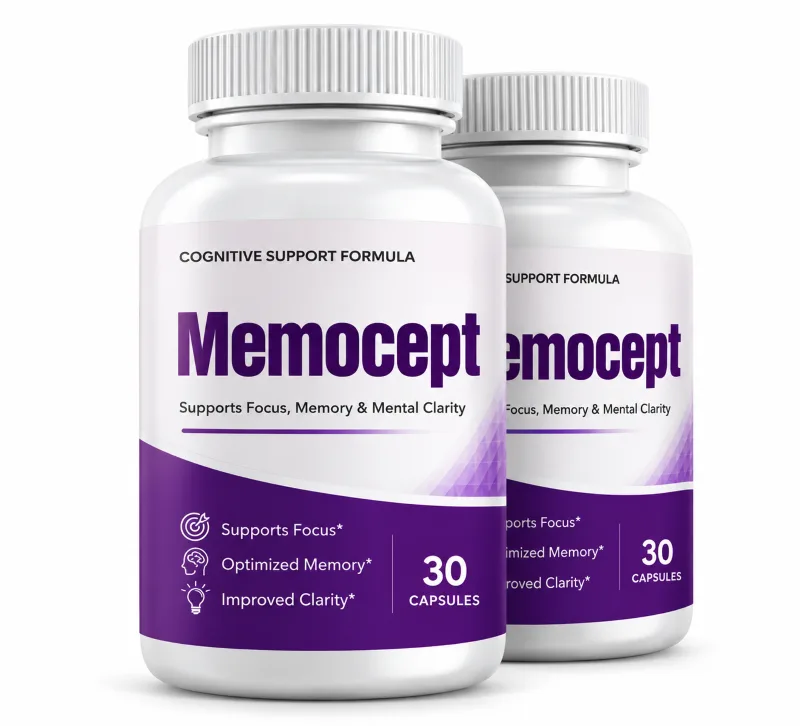
Memocept is marketed as a once-daily capsule intended to support focus, memory, clearer thinking, and mental energy.
The published product information says that one bottle contains 30 capsules, with a recommended serving of one capsule per day. The formula is based around amino acids associated with nitric-oxide production and circulation.
The basic idea is fairly straightforward.
Nitric oxide is involved in the regulation of blood-vessel dilation. L-arginine is a substrate used in nitric oxide production, while citrulline can contribute to arginine availability in the body.
The manufacturer therefore positions Memocept around a circulation-first concept: support healthy blood flow, provide nutritional support for the brain, and potentially help with everyday focus and mental clarity.
That approach is different from products that depend heavily on caffeine or other stimulants.
However, consumers should understand the distinction between supporting a biological pathway and proving a clinical outcome.
A supplement can contain ingredients that participate in a physiological process without having been demonstrated in a large clinical trial to improve memory in healthy adults.
That distinction is particularly important when evaluating brain supplements.

Memocept Ingredients: What’s Inside the Formula?
One of the more useful aspects of Memocept is that the published formula lists individual ingredients and their amounts.
According to the available product information, one capsule provides approximately:
| Ingredient | Published amount per capsule | General role |
| L-Arginine | 200 mg | Nitric-oxide pathway |
| L-Arginine AKG | 200 mg | Amino-acid and circulation support |
| L-Citrulline HCL | 100 mg | Arginine/nitric-oxide pathway |
| L-Citrulline Malate | 100 mg | Citrulline and energy-related support |
| Beta-Alanine | 40 mg | Amino-acid/endurance support |
| Niacin | 7.5 mg NE | Energy metabolism |
| Calcium | 18 mg | Normal cellular and nervous-system functions |
These amounts are based on the product’s published label information and should be checked against the package you actually receive because supplement formulations and labels can change.
L-Arginine
L-arginine is an amino acid that can be used by the body in the production of nitric oxide.
There is human research showing that intravenous L-arginine can increase cerebral blood flow under experimental conditions. One PubMed-indexed study found an increase in baseline whole-brain blood flow following L-arginine infusion.
However, this study used intravenous administration at a much different exposure than a small oral amount inside a dietary supplement.
Therefore, it would be inaccurate to say that this study proves Memocept improves memory.
What it does provide is biological context for why the ingredient is included.
L-Arginine AKG
L-arginine AKG combines arginine with alpha-ketoglutarate.
The product uses it as another component of its circulation-focused formulation.
There is a significant difference between including an ingredient because it has a plausible physiological role and having clinical evidence for a finished supplement.
For consumers, that means the ingredient list is interesting, but the overall formula still needs to be judged cautiously.
L-Citrulline
Citrulline is another amino acid connected to nitric-oxide metabolism.
The body can convert citrulline into arginine, which is one reason citrulline appears frequently in circulation and exercise-related formulas.
Memocept includes two forms: L-Citrulline HCL and L-Citrulline Malate.
The combination appears intended to complement the arginine components.
Again, this provides a plausible mechanism, but mechanism alone isn’t proof of a cognitive benefit.
Beta-Alanine
Beta-alanine is an amino acid most commonly associated with exercise performance and muscle carnosine.
Memocept uses a relatively small amount compared with doses commonly discussed in sports nutrition.
It is therefore better to view this ingredient as part of the broader formulation rather than expecting a dramatic effect on mental performance.
Niacin
Niacin, or vitamin B3, is an essential nutrient involved in energy metabolism and normal nervous-system function.
The product lists 7.5 mg NE, which the manufacturer’s information identifies as 47% of the Daily Value.
That does not mean that adding niacin automatically enhances memory.
Its role is more accurately described as nutritional support for normal physiological processes.
Calcium
Calcium is another essential nutrient and plays important roles in cellular signaling and normal nerve transmission.
The amount in this formula is relatively small.
It isn’t reasonable to consider the calcium content a primary reason to purchase the product, but it is part of the complete formula.
👉 Visit the Official Memocept Website & Learn More
How Does Memocept Work?
The central theory behind Memocept is relatively simple:
L-arginine + citrulline → nitric-oxide pathway → blood-vessel function and circulation → nutritional support for brain function.
This is biologically plausible.
The brain requires substantial blood flow to deliver oxygen and nutrients. Research has established important relationships between vascular health and cognitive function.
However, the next step requires caution.
Healthy blood flow does not automatically mean better memory.
Memory depends on a complicated combination of neural networks, sleep, attention, learning, aging, cardiovascular health, metabolic health, medications, mood, and many other factors.
The National Institute on Aging emphasizes this multifactorial nature of cognitive health.
So, rather than thinking:
“More nitric oxide equals better memory.”
a more scientifically responsible interpretation is:
“The formula contains ingredients involved in circulation, and healthy circulation is one factor associated with brain health.”
That is a much more realistic way to understand the product.
My Memocept Experience: What Should You Actually Expect?
I want to be careful here because a genuine personal experiment would require actually taking the product under controlled conditions.
Rather than inventing a personal result, the most useful approach is to explain what a reasonable evaluation would look like.
If I were testing Memocept for a review, I would not judge it after taking one capsule.
I would track:
- Ability to concentrate during long tasks
- Afternoon mental fatigue
- Ability to stay focused without distractions
- Ease of remembering routine information
- Subjective brain fog
- Sleep quality
- Energy levels
- Any unwanted effects
- Changes in blood pressure if medically appropriate
I would also keep caffeine intake, sleep schedule, and diet reasonably consistent.
Why?
Because memory and concentration naturally fluctuate.
One productive Tuesday does not prove a supplement works. Likewise, one tired Friday does not prove it doesn’t.
A meaningful supplement evaluation should look for a consistent pattern over time.
The manufacturer’s website suggests that some users report changes within a few weeks, with longer-term use extending the evaluation period. Those statements are customer/marketing claims, not the results of a randomized clinical trial on the finished product.
That distinction matters.
A real Case Study
Consider a 52-year-old office worker in Texas.
Let’s call him Michael.
Michael works at a computer for approximately eight hours each day. His biggest complaint isn’t severe memory loss. Instead, he feels that his concentration becomes weaker in the afternoon.
He sleeps around six to seven hours per night, drinks two cups of coffee each morning, exercises irregularly, and frequently skips lunch.
He decides to try Memocept.
Instead of immediately claiming that the supplement changed his memory, Michael tracks his experience.
Week 1
There is no dramatic change.
He continues his normal routine and records his afternoon concentration as average.
Week 2
Michael notices that some work sessions feel easier, but he isn’t sure whether this is from the supplement, better hydration, or simply having a lighter workload.
He doesn’t count this as proof.
Week 4
He reports that he is less distracted during longer tasks.
However, he also started walking 30 minutes several days a week.
Again, the result cannot reasonably be attributed entirely to Memocept.
Week 8
Michael looks back at his notes.
His sleep has improved, his exercise has increased, and his afternoon caffeine consumption has decreased.
He also reports somewhat better subjective concentration.
The correct conclusion would therefore not be:
“Memocept improved Michael’s memory.”
A more honest conclusion would be:
“Michael experienced an improvement in perceived concentration while using Memocept alongside several lifestyle changes, so the individual contribution of the supplement cannot be isolated.”
This is exactly why anecdotal experiences should not be treated like clinical evidence.
Memocept Pricing: How Much Does It Cost?
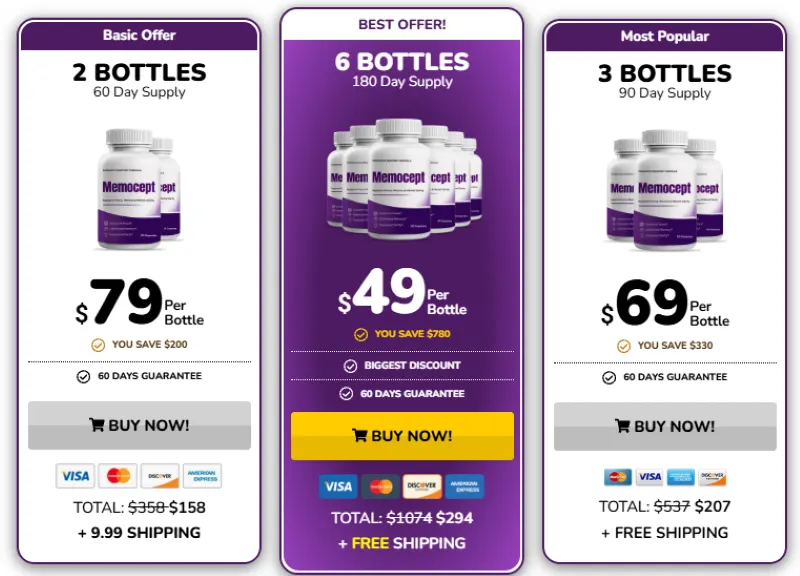
The current pricing displayed on the product website lists three packages:
| Package | Bottles | Published price | Approx. price/bottle |
| Basic | 2 | $158 + shipping | $79 |
| Popular | 3 | $207 | $69 |
| Larger package | 6 | $294 | $49 |
The product site currently advertises free U.S. shipping for the 3- and 6-bottle packages and a 60-day money-back guarantee. Prices can change, so consumers should verify the checkout page before ordering.
👉 See the Latest Memocept Offers on the Official Website
Memocept Benefits: What Could It Support?
Based on its formulation and intended use, the potential areas of support include:
1. Everyday Focus
The product is marketed for maintaining concentration during mentally demanding activities.
This may be particularly relevant to people who experience occasional distraction or mental fatigue.
2. Mental Clarity
Some consumers use supplements because they describe feeling mentally “foggy.”
That phrase is broad, however, and can have many causes, including insufficient sleep, stress, dehydration, medication effects, mood problems, nutritional deficiencies, or other medical issues.
3. Memory Support
Memory support is one of the product’s main marketing themes.
However, there is currently no strong evidence showing that the finished Memocept formula prevents age-related memory decline or treats dementia.
NCCIH states that evidence for dietary supplements marketed for cognitive function remains limited and inconsistent, and recommends not delaying medical evaluation when someone develops meaningful memory problems.
4. Circulation Support
This is arguably the clearest mechanistic feature of the formula.
Several of its amino acids are connected with nitric-oxide metabolism and vascular function.
5. Stimulant-Free Formula
The published ingredient list does not include caffeine.
For someone who is sensitive to caffeine, this may be preferable to stimulant-heavy products.
Memocept Pros and Cons
| Pros | Cons |
| Once-daily capsule | Finished product lacks large independent clinical trials |
| Seven listed ingredients | Several ingredient amounts are relatively modest |
| No caffeine listed | Memory claims should not be interpreted as disease treatment |
| Individual ingredients are disclosed | Results can vary substantially |
| Made in the USA according to manufacturer information | Supplement status means it is not FDA-approved as a drug |
| 60-day money-back guarantee according to product site | Price can become significant for long-term use |
| Circulation-focused formulation | People taking certain medications should check with a healthcare professional |
The biggest positive is transparency around the listed ingredients.
The biggest limitation is equally important: ingredient-level evidence is not the same thing as clinical evidence for the finished product.
Where to Buy Memocept
The product website currently directs consumers to purchase through its online sales channel rather than a conventional retail-store distribution model.
For consumers searching for where to buy Memocept, the safest approach is to verify the seller, product labeling, refund policy, and current price before entering payment information.
You can check the current product information here:
Because dietary supplements can be sold through third-party websites, consumers should be cautious with unfamiliar listings. The FDA recommends reading supplement labels carefully and discussing supplements with a healthcare professional when appropriate.

What Does Science Say About Brain Supplements?
This is where the review becomes more important than the marketing.
Research on dietary supplements and cognition is mixed.
NCCIH notes that some natural products have produced modest findings in individual studies, but direct evidence that dietary supplements prevent Alzheimer’s disease or other forms of dementia is lacking.
A systematic review of long-term randomized controlled trials also concluded that, across the nutraceuticals examined, evidence was not compelling enough to broadly support their use for improving cognition in older adults.
Another systematic review and meta-analysis found that omega-3 fatty acids, B vitamins, and vitamin E did not improve cognition in non-demented middle-aged and older adults, while noting that other nutritional interventions required further evaluation.
At the same time, research is not uniformly negative.
For example, an NIH-supported clinical trial involving more than 3,500 adults aged 60 and older found modest memory improvements with daily multivitamin supplementation over three years. The researchers also noted the need for additional research and more diverse participants.
The lesson is simple:
Brain nutrition is complicated, and no single supplement should be treated as a magic solution.
How to Get Better Results From a Brain-Support Routine
Regardless of whether someone chooses Memocept, the foundation should remain lifestyle.
The National Institute on Aging recommends paying attention to factors such as physical activity, cardiovascular health, diet, social engagement, and management of health conditions.
A practical routine might include:
- Getting consistent, adequate sleep
- Exercising regularly
- Eating a nutrient-dense diet
- Staying hydrated
- Managing blood pressure and blood sugar
- Limiting excessive alcohol
- Avoiding smoking
- Keeping the brain socially and intellectually engaged
- Reviewing medications that may affect concentration
- Getting persistent or worsening memory problems evaluated
A supplement should complement these habits rather than replace them.
Memocept Safety and Possible Side Effects
Although the listed ingredients are familiar nutritional compounds, “natural” does not automatically mean risk-free.
The most important issue to consider with this formulation is its circulation-focused ingredients.
L-arginine and citrulline can influence nitric-oxide pathways and blood-vessel function. People taking blood-pressure medicines, nitrates, or certain medications for erectile dysfunction should discuss the product with a healthcare professional before use.
Anyone with a cardiovascular condition, unusually low blood pressure, or a complex medication regimen should also seek professional advice.
The FDA specifically recommends talking with a doctor, pharmacist, or other healthcare professional before starting dietary supplements because supplements can interact with medicines and may cause unwanted effects.
Also remember that meaningful or rapidly worsening memory problems should not simply be treated with a supplement.
NCCIH points out that potentially treatable issues—including medication reactions, depression, and certain thyroid, liver, or kidney problems—can affect memory.
Memocept Results: How Long Could It Take?
There is no scientifically established timeline for the finished product.
The manufacturer’s website describes user-reported changes over several weeks, but those reports are not equivalent to controlled clinical research.
Therefore, a realistic evaluation might look like this:
First 1–2 Weeks
Don’t expect dramatic memory changes.
Pay attention to tolerance and any unwanted effects.
Weeks 3–4
Look for consistent changes in concentration rather than isolated “good days.”
Weeks 5–8
If you are using the product consistently, review your notes and compare them with your baseline.
Around 60 Days
Decide whether the product has provided enough noticeable value to justify continued use.
The most useful approach is to measure your own experience rather than assuming that someone else’s testimonial will apply to you.
My Overall Assessment of Memocept
After looking at the formulation, published product information, available ingredient research, pricing, and the broader scientific evidence, I would describe Memocept as an interesting but not clinically proven cognitive-support supplement.
Its formula has a coherent theme.
The arginine and citrulline ingredients are connected with nitric-oxide biology and circulation. Niacin contributes to normal energy metabolism, while the remaining nutrients provide additional nutritional components.
The formula is also relatively easy to understand because the individual ingredients and quantities are listed.
However, there is a major limitation.
I did not find evidence of a large, independent randomized controlled trial demonstrating that the finished Memocept formula improves memory, prevents cognitive decline, or treats dementia.
That doesn’t automatically mean the product is ineffective.
It means the evidence should be interpreted at the correct level.
The research supports biological plausibility for some ingredients, while the clinical evidence for the complete formula remains limited.
That is an important distinction for any responsible 2026 supplement review.
Scientific Resources Worth Checking
If you are researching Memocept or any other cognitive supplement, don’t rely only on product websites.
These are useful places to investigate the underlying science:
National Institutes of Health (NIH) — Provides research summaries and health information.
National Institute on Aging (NIA) — Useful information on cognitive health, aging, memory, and lifestyle factors.
National Institute on Aging
PubMed — A major database for peer-reviewed biomedical research.
PubMed
National Center for Complementary and Integrative Health (NCCIH) — Particularly useful for evaluating supplements and complementary approaches.
NCCIH
U.S. Food and Drug Administration (FDA) — Useful for understanding how dietary supplements are regulated in the United States.
FDA Dietary Supplements
These sources are especially valuable because they allow consumers to distinguish between marketing claims, preliminary evidence, and stronger clinical evidence.
Frequently Asked Questions
1. What is Memocept?
Memocept is a once-daily dietary supplement marketed to support focus, memory, mental clarity, and healthy circulation. Its published formula contains seven ingredients, including L-arginine, L-citrulline, beta-alanine, niacin, and calcium.
2. Does Memocept improve memory?
There is not enough independent clinical evidence to conclude that the finished formula improves memory. Some ingredients have biological research behind them, but ingredient evidence is not the same as a clinical trial of the complete product.
3. What is Memocept pricing?
The product website currently lists packages at $158 for two bottles, $207 for three bottles, and $294 for six bottles. The displayed prices may change, so verify the current checkout price before purchasing.
4. How many capsules are in a bottle?
The product information states that each bottle contains 30 capsules and is intended to provide approximately a one-month supply when taking one capsule daily.
5. Are Memocept capsules suitable for everyone?
No supplement is suitable for everyone. People taking medications, particularly medications that affect blood pressure or vascular function, should ask a healthcare professional before using this type of formulation.
Final Verdict: Should You Try Memocept?
Memocept has a clearly defined concept: support everyday mental performance through a formula centered on amino acids involved in nitric-oxide and circulation pathways.
The ingredient list is straightforward, the product is easy to take, and the formula does not rely on caffeine.
But it is equally important not to overstate what the evidence proves.
There is scientific support for some of the biological mechanisms behind individual ingredients, including research showing that L-arginine can affect cerebral blood flow under experimental conditions.
At the same time, broader research into dietary supplements for cognition remains mixed, and major health organizations caution that there is not enough evidence to recommend supplements as a way to prevent dementia or Alzheimer’s disease.
So, if your goal is everyday focus and nutritional support, Memocept may be something to research further.
If you are experiencing significant or worsening memory problems, however, don’t use a supplement as a substitute for medical evaluation.
Ultimately, the most sensible way to judge any cognitive supplement is to look at the ingredient evidence, dosage, safety, cost, transparency, and your own measurable response rather than relying solely on dramatic before-and-after claims.
That is the approach I would use when evaluating Memocept in 2026.
Author


Your Health Rights is a U.S.-based health and wellness platform dedicated to empowering readers with clear, research-backed content across Men’s Health, Women’s Health, Weight Loss, Health Supplements, and Immunity & General Wellness.


