


If your eyes feel tired after a long day of staring at a laptop, phone, or television, you are certainly not alone. Screen-heavy lifestyles have made eye comfort and long-term vision wellness a bigger concern for many adults. This is one reason nutritional formulas designed around carotenoids and antioxidants have become increasingly popular.
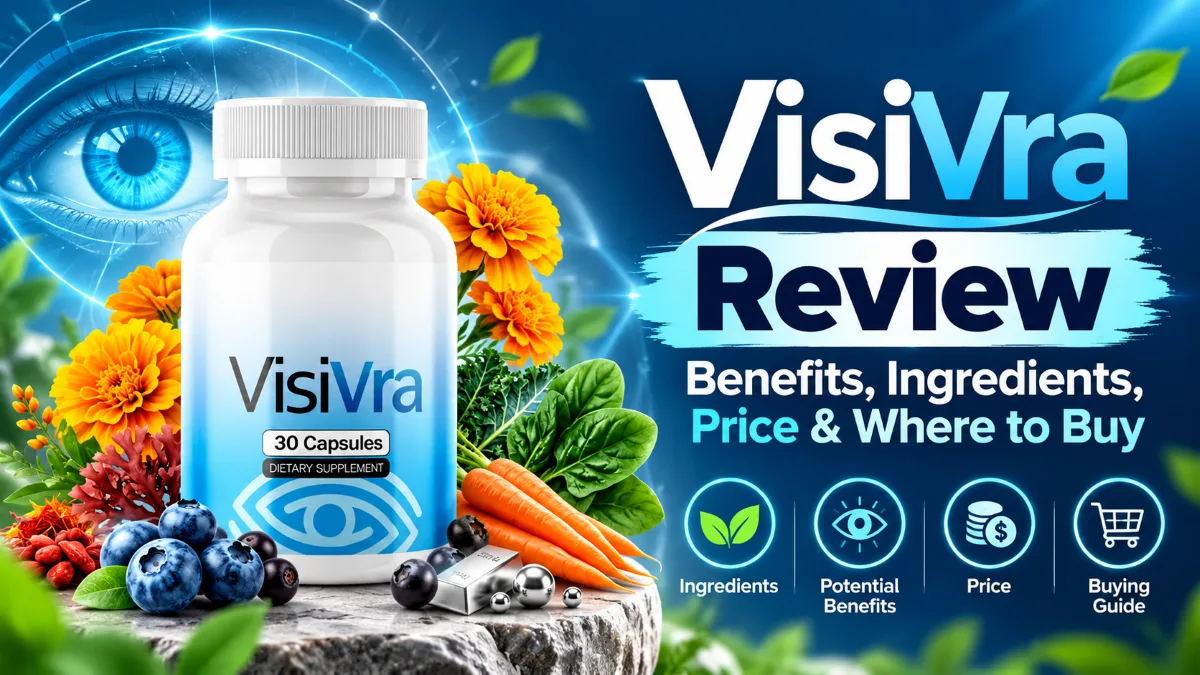
In this Visivra Review 2026, I’m taking a closer look at what this supplement is, what ingredients are listed in the formula, what the manufacturer says it is designed to support, how the current pricing works, and where consumers in the United States can purchase it.
The important thing to understand from the beginning is that Visivra is a dietary supplement, not an eye disease treatment. Its formula contains nutrients associated with eye and retinal health, but supplements should not replace an eye examination, prescription glasses, contact lenses, or treatment recommended by an ophthalmologist or optometrist.
So, is Visivra worth considering for everyday eye nutrition? Let’s take a closer look.
Quick Answer: Is Visivra Worth Considering?
Visivra is a once-daily eye-health supplement built around lutein, zeaxanthin, bilberry extract, astaxanthin, zinc, and vitamin A. According to the manufacturer’s current website, it is produced in the USA in a GMP-compliant facility and is marketed toward adults looking for nutritional support for visual comfort, screen-heavy lifestyles, and general eye wellness.
The current manufacturer-listed pricing starts at $79 per bottle for the two-bottle package, while larger packages reduce the per-bottle cost. The manufacturer also advertises a 60-day money-back guarantee.
However, there is an important distinction between the ingredients in a supplement and clinical evidence for a finished product. Research supports the importance of certain nutrients for eye health, but that does not automatically mean the finished supplement can prevent, diagnose, or treat an eye condition.
My overall view: Visivra may be interesting for someone looking for a convenient nutritional approach to everyday eye wellness, particularly if their diet is lacking carotenoid-rich foods. People with diagnosed eye conditions should speak with an eye-care professional before choosing a supplement.
What Is Visivra?
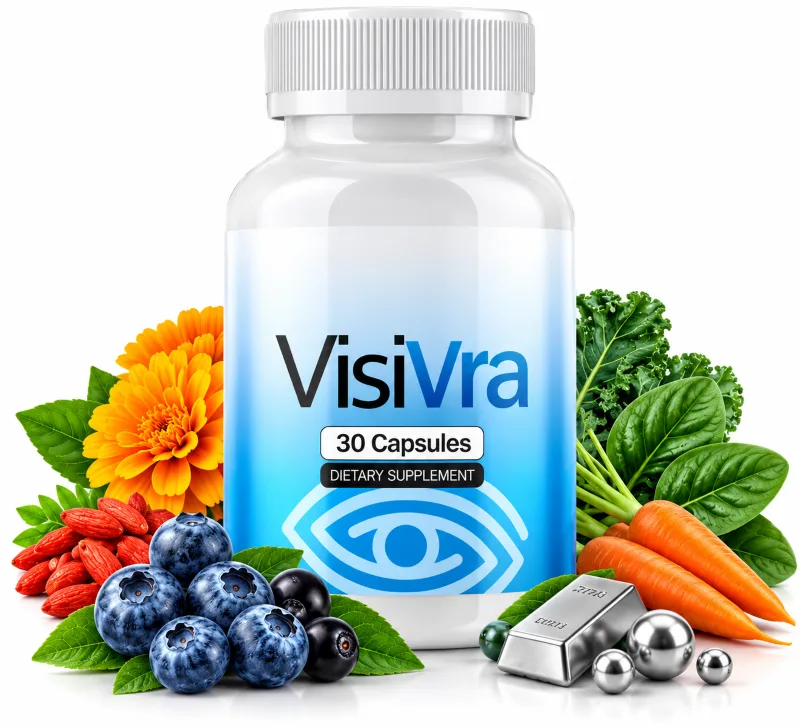
Visivra is marketed as a daily vision-support supplement containing a combination of carotenoids, antioxidants, vitamins, and minerals.
The manufacturer’s current formula lists six primary active ingredients:
- Lutein
- Zeaxanthin
- Bilberry extract
- Astaxanthin
- Zinc
- Vitamin A
The concept behind Visivra is relatively straightforward. Instead of relying on a single vitamin, the formula combines several nutrients associated with different aspects of eye nutrition.
Lutein and zeaxanthin are particularly interesting because they are carotenoids found in the macula, the central part of the retina involved in detailed vision. The National Eye Institute has also studied lutein and zeaxanthin as part of the AREDS2 formulation for people with specific stages of age-related macular degeneration.
That does not mean Visivra is the same as AREDS2. It isn’t. The AREDS2 formula contains specific quantities of vitamin C, vitamin E, zinc, copper, lutein, and zeaxanthin and was studied in people with particular stages of AMD.
This distinction matters when evaluating any vision supplement.

Visivra Review: How Does It Work?
Rather than thinking about Visivra as something that suddenly “improves eyesight,” it makes more sense to look at the nutritional role of its ingredients.
The eye is metabolically active tissue and is exposed to light and oxidative stress throughout life. Nutrients involved in antioxidant protection and retinal function therefore receive considerable scientific interest.
Lutein and Zeaxanthin
Lutein and zeaxanthin are dietary carotenoids concentrated in the macula.
They are often discussed in relation to macular pigment and protection against certain forms of light-related oxidative stress. These nutrients are also included in the AREDS2 formula studied by the National Eye Institute.
This is arguably the strongest scientific rationale behind the formula.
However, the clinical evidence should be interpreted correctly. AREDS2 was designed for people with specific stages of AMD and should not be interpreted as proof that every healthy person taking lutein and zeaxanthin will experience sharper eyesight.
Bilberry Extract
Bilberry is a berry containing anthocyanins and other plant compounds.
Bilberry supplements have historically been marketed for circulation, night vision, and eye health. However, evidence for specific eye-related outcomes is not as strong or established as the evidence surrounding the AREDS2 formula for intermediate-to-advanced AMD.
Therefore, I would consider bilberry an interesting supporting ingredient rather than the primary reason to choose a supplement.
Astaxanthin
Astaxanthin is another carotenoid with antioxidant properties.
It is naturally found in certain marine organisms and has attracted research interest because of its antioxidant activity. Supplement manufacturers commonly include it in formulas aimed at supporting visual comfort and general antioxidant protection.
Still, consumers should be careful with phrases such as “restores eyesight” or “reverses vision problems.” Those claims go much further than what can reasonably be concluded from the presence of astaxanthin in a supplement.
Zinc
Zinc is an essential mineral involved in numerous biological processes, including normal cellular function.
The retina contains zinc, and zinc has also been incorporated into the AREDS/AREDS2 research formulations.
However, more zinc is not automatically better. The correct amount depends on the overall diet, other supplements being taken, and individual circumstances.
Vitamin A
Vitamin A is essential for normal vision.
A deficiency can interfere with normal visual function, particularly under low-light conditions. This makes vitamin A a logical nutrient in a general eye-nutrition formula.
At the same time, high supplemental intake of certain forms of vitamin A can be problematic. This is another reason to avoid stacking multiple high-dose supplements without checking the labels.
Check Visivra Pricing & Availability on the Official Website
Visivra Ingredients at a Glance
| Ingredient | Why it is included | Evidence perspective |
| Lutein | Macular carotenoid and antioxidant | Strong scientific interest; included in AREDS2 |
| Zeaxanthin | Macular carotenoid | Strong scientific interest; included in AREDS2 |
| Bilberry extract | Anthocyanin-rich botanical | Evidence is more limited for specific eye outcomes |
| Astaxanthin | Antioxidant carotenoid | Promising nutritional research but not a treatment |
| Zinc | Essential mineral involved in retinal function | Well established nutrient; used in AREDS/AREDS2 |
| Vitamin A | Important for normal vision | Essential nutrient, especially relevant to deficiency |
One limitation of evaluating any supplement online is that ingredient presence alone doesn’t tell you everything. Dosage matters. The amount used in a clinical trial may be very different from the amount contained in a commercial supplement.
For that reason, consumers should look at the complete Supplement Facts panel rather than judging a product solely by the ingredient names.
Potential Visivra Benefits
The manufacturer positions Visivra around several areas of everyday eye wellness. Based on the ingredients and the way the product is marketed, potential areas of interest include nutritional support for:
1. General Eye Nutrition
A diet containing leafy greens, colorful vegetables, eggs, fish, and other nutrient-dense foods can provide nutrients associated with healthy eyes.
A supplement can be considered an addition to—not a replacement for—a healthy diet.
2. Macular Nutrient Support
Lutein and zeaxanthin are particularly relevant because they are naturally present in the macula.
The scientific interest surrounding these nutrients is substantial, especially because of their role in the AREDS2 research program.
3. Screen-Heavy Lifestyles
Many people spend much of their working day looking at computers and phones.
This can contribute to symptoms such as temporary eye fatigue, discomfort, dryness, or difficulty maintaining comfortable focus.
A nutritional supplement may be part of an overall eye-care routine, but simple behavioral strategies remain important. The National Eye Institute recommends healthy lifestyle measures and regular eye examinations as part of maintaining eye health.
4. Antioxidant Support
Several ingredients in Visivra have antioxidant properties.
This is relevant because oxidative stress is an important area of research in eye biology. But “antioxidant support” should not be interpreted as a guarantee against an eye disease.
Visivra and Digital Eye Strain
This is one area where expectations need to remain realistic.
If you work eight or ten hours a day at a computer, taking a capsule doesn’t eliminate the need for good screen habits.
Try combining nutritional support with habits such as:
- Following the 20-20-20 approach during long periods of close screen work.
- Taking regular breaks from continuous screen viewing.
- Adjusting screen brightness and room lighting.
- Keeping the monitor at a comfortable distance.
- Remembering to blink regularly.
- Getting adequate sleep.
- Wearing appropriate prescription glasses when necessary.
- Scheduling professional eye examinations.
In other words, Visivra should be viewed as one possible component of an eye-health routine, not a substitute for basic eye care.
Visivra Review 2026: What About the Science?
This is probably the most important part of any supplement review.
There is legitimate scientific evidence behind some of the nutrients in the formula, but that evidence needs to be separated from marketing claims.
The National Eye Institute’s AREDS and AREDS2 trials found that specific supplement formulations can reduce the risk of progression from intermediate to advanced AMD by about 25% in appropriate patients.
But there is a major qualification.
Those findings apply to specific AREDS/AREDS2 formulations and specific AMD populations. They do not mean every eye supplement produces the same result.
The NEI specifically notes that AREDS/AREDS2 supplements did not benefit people without AMD or those with early AMD in the same way.
Therefore, someone diagnosed with AMD should not simply purchase Visivra and assume it is an alternative to a doctor-recommended AREDS2 product.
This is an important point that many online reviews fail to explain.
Check the Latest Visivra Price & Ordering Options Online
Visivra vs. AREDS2: Are They the Same?
No.
This is worth emphasizing.
| Feature | Visivra | AREDS2 |
| Purpose | General eye nutrition | Specific clinical use for certain AMD patients |
| Lutein | Included | 10 mg |
| Zeaxanthin | Included | 2 mg |
| Zinc | Included | 80 mg in the standard formulation |
| Vitamin C | Not listed among the six primary actives | 500 mg |
| Vitamin E | Not listed among the six primary actives | 400 IU |
| Copper | Not listed among the six primary actives | 2 mg |
| Clinical trial formulation | No | Yes |
| Appropriate for diagnosed AMD? | Ask an eye doctor | Discuss with an eye-care professional |
The NEI recommends discussing AREDS2 supplementation with a physician or eye-care professional when appropriate.
So, if your primary reason for buying an eye supplement is a diagnosis of AMD, don’t use a general wellness product as a substitute for professional guidance.
Visivra Pricing: How Much Does It Cost?
According to the current official product website, the advertised package options are:
| Package | Bottles | Advertised Total | Approx. Cost/Bottle |
| Starter | 2 | $158 + shipping | $79 |
| Popular | 3 | $207 | $69 |
| Best Value | 6 | $294 | $49 |
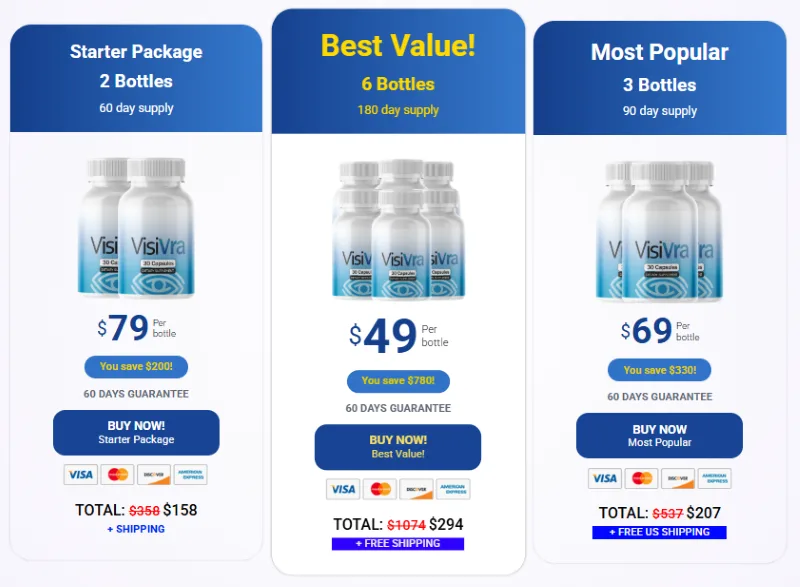
The manufacturer currently advertises free U.S. shipping on the three- and six-bottle packages and a 60-day money-back guarantee.
Because supplement prices and promotional offers can change, consumers should verify the checkout price before placing an order.
If you see a substantially different price on an unfamiliar marketplace, check whether you are purchasing from an authorized source and whether the stated guarantee actually applies.
Check Visivra Current Pricing…….
What I Like About Visivra
The first thing I like about Visivra is that its formula is built around recognizable eye-nutrition ingredients rather than an extremely long proprietary ingredient list.
Lutein and zeaxanthin are particularly noteworthy because of their established presence in eye-health research.
I also like that the product is positioned as a nutritional supplement rather than something consumers should use instead of medical care.
The one-a-day format is another practical advantage. People are more likely to stick with a routine when it is simple.
Finally, the manufacturer provides package and guarantee information directly on its website, which makes it easier for consumers to understand the current purchasing options.
Visivra Capsules: How Should They Be Taken?
The manufacturer’s instructions currently recommend taking one capsule daily with water and a meal.
Taking supplements consistently is generally more practical than taking them sporadically.
However, don’t increase the serving simply because you think a higher dose will work faster.
If you already take a multivitamin, vitamin A supplement, zinc, or another eye-health formula, compare the labels to avoid unnecessary duplication.
If you’re taking prescription medication, pregnant, breastfeeding, or managing an eye condition, speak with a healthcare professional before adding a supplement.
Visivra Where to Buy
The product is currently promoted through its online sales channel rather than ordinary retail stores. Current product information identifies the Visivra official website as the primary purchasing route.

Can Visivra Improve Eyesight?
This is where marketing language needs to be separated from science.
A nutritional supplement cannot be expected to correct refractive errors such as nearsightedness, farsightedness, or astigmatism.
Those conditions are generally addressed with prescription lenses, contact lenses, or appropriate medical procedures.
Similarly, a supplement shouldn’t be promoted as a guaranteed treatment for glaucoma, cataracts, AMD, retinal disease, or other eye disorders.
The more reasonable way to describe Visivra is as a nutritional eye-support product.
That distinction is important for consumers searching for healthy vision support online.
Lifestyle Habits That Matter as Much as Supplements
A capsule is only one small piece of the bigger picture.
For long-term vision wellness, consider the basics:
Eat a varied diet
Dark leafy greens, colorful vegetables, eggs, nuts, fish, and other nutrient-rich foods can contribute to a balanced diet.
Protect your eyes from excessive sunlight
Good-quality sunglasses can reduce exposure to ultraviolet radiation.
Don’t smoke
Smoking is associated with several serious health problems, including increased risk for certain eye diseases.
Manage overall health
Conditions such as diabetes and cardiovascular disease can affect eye health, making regular healthcare important.
Get regular eye examinations
Many eye diseases develop without obvious symptoms during their early stages.
The National Eye Institute recommends eye-health habits such as eating healthy foods, protecting the eyes, and obtaining appropriate eye examinations.
Visivra Reviews: What Should Buyers Look For?
When reading online reviews, don’t focus only on five-star ratings.
Instead, look for specific information:
Who used the product?
A 25-year-old with normal vision is different from someone diagnosed with AMD.
How long did they use it?
A review after three days doesn’t tell you much about a nutritional routine intended for long-term use.
What else changed?
If someone changed their diet, glasses, sleep, screen habits, and supplement at the same time, it’s impossible to know what caused an improvement.
Are the claims medically reasonable?
Claims such as “cures eye disease” or “restores perfect vision” should immediately raise questions.
A trustworthy review should acknowledge both potential benefits and limitations.
Frequently Asked Questions
1. What is Visivra?
Visivra is a daily dietary supplement marketed for general eye nutrition. Its current formula lists lutein, zeaxanthin, bilberry extract, astaxanthin, zinc, and vitamin A.
2. What are the main Visivra ingredients?
The manufacturer currently identifies six primary ingredients: lutein, zeaxanthin, bilberry extract, astaxanthin, zinc, and vitamin A.
3. Is Visivra good for people who use computers?
The product is marketed toward adults with screen-heavy lifestyles. However, good screen habits—regular breaks, appropriate lighting, proper viewing distance, and eye examinations—remain important.
4. How long does Visivra take to work?
The manufacturer states that users may notice changes in comfort, screen tolerance, or clarity within several weeks, but individual experiences vary. There is not enough evidence to promise a specific timeline for everyone.
5. Is Visivra safe?
The manufacturer states that its product is produced in a GMP-compliant U.S. facility. However, individual suitability varies. Anyone taking medication, pregnant or breastfeeding, or managing an eye condition should consult a healthcare professional before use.
Final Verdict: Is Visivra Worth It?
After looking at the formula, available scientific information, pricing, and the distinction between general eye nutrition and clinically studied eye-disease formulas, I would describe Visivra as a reasonable nutritional eye-support option rather than a miracle eyesight product.
Its strongest selling point is the inclusion of lutein and zeaxanthin, two carotenoids with substantial scientific interest and a role in the AREDS2 research program. Zinc and vitamin A also have established nutritional relevance to normal visual function.
At the same time, consumers should not confuse the ingredients with proof that the finished supplement can treat an eye disease.
If your goal is simply to add a convenient eye-health supplement to an already healthy lifestyle, Visivra may be worth researching.
If you have persistent blurry vision, flashes, floaters, eye pain, sudden vision changes, AMD, glaucoma, diabetic eye disease, or another diagnosed condition, your first step should be an eye-care professional—not an online supplement.
For U.S. buyers, the manufacturer currently directs customers to its official website for purchasing and lists package pricing ranging from $79 per bottle on the two-bottle package to $49 per bottle on the six-bottle package.
Ultimately, the smartest approach is simple: use nutrition to support your eyes, but don’t use supplements as a substitute for professional eye care.
Scientific & Reference Sources
For readers who want to research the science independently, these are useful starting points:
- National Eye Institute (NEI) — Healthy Vision information and eye-care guidance.
- National Eye Institute — AREDS/AREDS2 — Clinical research concerning nutritional supplementation and age-related macular degeneration.
- National Eye Institute — AREDS2 Supplements — Information about the specific nutrients and populations for whom AREDS2 may be appropriate.
- National Eye Institute — AREDS/AREDS2 FAQ — Detailed explanation of the evidence, formulations, and limitations of AREDS supplementation..
Medical disclaimer: This article is for informational purposes only and does not constitute medical advice. Visivra is a dietary supplement and should not be used to diagnose, treat, cure, or prevent disease. Individual results may vary. Always speak with a qualified healthcare professional about persistent vision changes or before starting a new supplement, particularly if you have an existing eye condition or take medication.
Author


Your Health Rights is a U.S.-based health and wellness platform dedicated to empowering readers with clear, research-backed content across Men’s Health, Women’s Health, Weight Loss, Health Supplements, and Immunity & General Wellness.