

Eye health is something many people overlook until they start experiencing problems such as tired eyes, dryness, blurred vision, or difficulty focusing. With increasing screen time, long working hours, and everyday exposure to digital devices, maintaining healthy vision has become an important part of overall wellness.
This is one reason why eye health supplements have attracted attention among adults looking for additional nutritional support. One product that deserves a closer look is VisualEase. It is presented as an eye wellness supplement, but before considering any new product, it is important to understand what it contains, how it is supposed to work, its potential benefits, and whether there is enough evidence to support its claims.
In this detailed VisualEase Review, we will examine the available product information, discuss the science behind common eye-support ingredients, explore possible advantages and limitations, and explain what consumers should check before purchasing.
So, is VisualEase worth considering, or should buyers be cautious? Let’s explore everything you should know.
Quick Answer: Is VisualEase Scam or Legit?
VisualEase is marketed as an eye health supplement intended to support general vision wellness. However, there is currently insufficient independently verified information available to establish its exact ingredient formula, manufacturing standards, clinical effectiveness, or customer satisfaction.
This does not automatically mean the product is a scam. However, consumers should avoid treating its promotional claims as scientifically proven until reliable product documentation is available.
Quick overview:
| Category | Details |
| Product name | VisualEase |
| Product type | Eye health dietary supplement |
| Form | Capsules (verify current packaging) |
| Main purpose | General eye and vision wellness |
| Ingredients | Require verification from the product label |
| FDA approval | Dietary supplements are not FDA-approved |
| Official website | Verify the Official website before purchasing |
| Price | Current pricing requires verification |
| Overall assessment | More independent verification needed |
Our initial verdict: VisualEase should be approached with reasonable caution. Check the complete ingredient label, seller information, refund policy, and independent customer feedback before making a purchase.
What Is VisualEase?
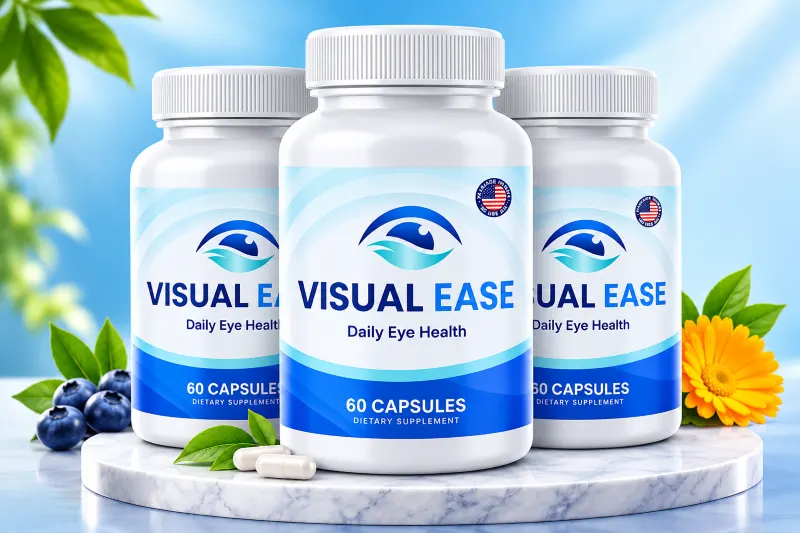
VisualEase is presented as a dietary supplement designed for people interested in maintaining their eye health and supporting everyday visual wellness.
Modern lifestyles can place considerable demands on our eyes. Spending several hours looking at computers, smartphones, televisions, and other digital screens may contribute to temporary eye discomfort, particularly when people forget to blink regularly or take breaks.
Nutrition is another important consideration. The eyes require several essential nutrients to maintain their normal structure and function. Vitamins, minerals, and antioxidant compounds obtained through a balanced diet contribute to overall health, including eye health.
The idea behind products such as VisualEase is to provide additional nutritional support through a convenient supplement format.
However, it is important to understand that an eye supplement cannot automatically correct refractive errors, eliminate the need for glasses, or treat conditions such as glaucoma, cataracts, or macular degeneration.
Before deciding whether this product is appropriate, consumers should examine its actual ingredients and the scientific evidence supporting them.

How Does VisualEase Work?
The advertised purpose of VisualEase is to provide nutritional support for eye wellness. However, without a verified ingredient list and exact dosages, it is not possible to explain the product’s specific mechanism of action.
Generally, nutritional formulas intended for eye health may contain vitamins, minerals, and antioxidant compounds that participate in normal eye function.
Here are some examples of ingredients commonly discussed in eye nutrition research.
1. Lutein
Lutein is a carotenoid found in foods such as spinach, kale, broccoli, and other green vegetables.
It is naturally present in the macula, an important area of the retina responsible for detailed central vision.
Research has investigated lutein’s role in supporting macular health, particularly as part of specific nutritional combinations.
However, consumers should check whether VisualEase actually contains lutein and how much is included.
2. Zeaxanthin
Zeaxanthin is another carotenoid naturally found in the retina.
It is commonly studied alongside lutein because both compounds are present in the macular region.
These nutrients are included in certain clinically studied eye-health formulations. Nevertheless, the benefits of a particular supplement depend on its complete formulation, dosage, and the individual’s health circumstances.
3. Vitamin C
Vitamin C is an antioxidant that helps protect cells from oxidative stress and supports several normal bodily functions.
It is found in foods such as oranges, strawberries, bell peppers, and kiwi.
Vitamin C is also included in the AREDS2 nutritional formulation studied for people with certain stages of age-related macular degeneration.
4. Vitamin E
Vitamin E is a fat-soluble antioxidant that helps protect cells from oxidative damage.
It is naturally available in nuts, seeds, vegetable oils, and other foods.
However, taking additional vitamin E does not automatically improve eyesight. High supplemental doses may also create health risks or interact with medications.
5. Zinc
Zinc is an essential mineral involved in numerous biological processes.
It plays a role in normal retinal function and is included in certain clinically studied nutritional formulas for age-related macular degeneration.
The appropriate amount depends on individual nutritional needs and the specific supplement formulation.
Important: These are examples of nutrients studied in relation to eye health. They should not be interpreted as a confirmed list of VisualEase ingredients. Always check the actual product label before purchasing.
Potential Benefits of VisualEase
The advertised purpose of this product is to support everyday eye wellness. If its formula contains appropriate nutrients in suitable amounts, it may offer nutritional support as part of a balanced lifestyle.
Let’s look at some potential areas of interest.
1. Supports General Eye Nutrition
The eyes require several nutrients to maintain normal function. A supplement containing appropriate vitamins and minerals may help individuals address certain nutritional gaps.
However, supplements should complement a healthy diet rather than replace nutritious foods.
2. Supports Normal Retinal Function
The retina plays an essential role in processing light and sending visual information to the brain.
Certain nutrients, including vitamin A and zinc, contribute to normal visual function. Other nutrients are being studied for their roles in retinal health.
The actual contribution of VisualEase cannot be established without verifying its formulation.
3. Provides Additional Antioxidant Nutrients
Antioxidants help protect cells from oxidative stress.
Some eye-health formulas contain antioxidant vitamins and carotenoids. Their effectiveness depends on the specific ingredients and the health condition being considered.
4. Convenient Daily Supplement Format
For people who have difficulty consistently meeting their nutritional requirements through food, a properly formulated supplement may provide a convenient option.
Still, convenience should never be the only reason to choose a product. Ingredient quality, dosage, safety, and suitability matter much more.
5. Encourages Better Eye-Care Awareness
Considering an eye wellness product may encourage consumers to pay more attention to their everyday habits.
This includes taking screen breaks, eating nutrient-rich foods, getting regular eye examinations, and protecting their eyes from excessive sunlight.
These habits are important regardless of whether someone uses a supplement.
VisualEase Price: How Much Does It Cost?
The reviewed sales pages show different package offers:
| Package advertised | Price shown | Approximate price per bottle |
| 2 bottles | $178 on one page | $89 |
| 3 bottles | $216 on one page | $72 |
| 6 bottles | $294 on one page | $49 |
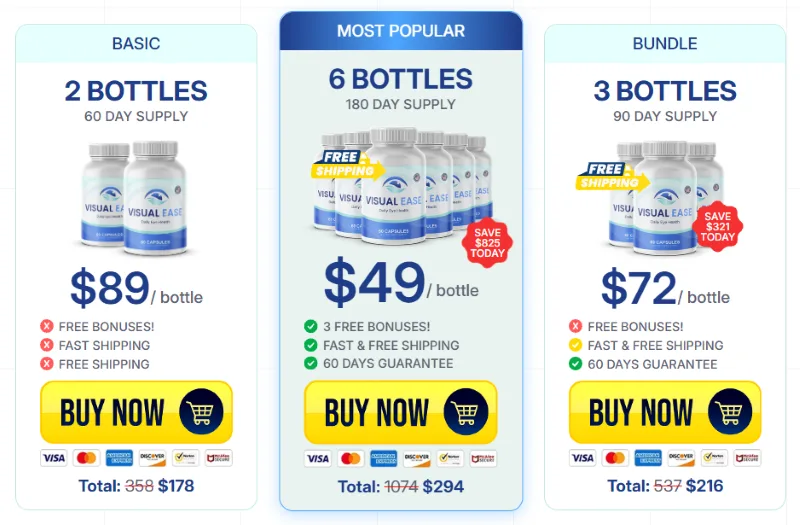
Supplement prices can change depending on the seller, package quantity, promotional offers, and shipping location.
When evaluating the price, consider more than the advertised discount.
Check the following:
- Price of a single bottle.
- Price of multiple-bottle packages.
- Cost per serving.
- Shipping and handling charges.
- Applicable taxes.
- Refund eligibility and conditions.
A lower price does not necessarily mean better value. Similarly, an expensive supplement is not automatically more effective.
Consumers should compare the ingredient amounts and manufacturing transparency before deciding whether the product offers reasonable value.
VisualEase Pros and Cons
Before making a purchasing decision, it is helpful to consider both the possible advantages and the limitations.
| Potential Pros | Potential Cons |
| Designed for people interested in eye wellness | Exact ingredients require verification |
| Supplement format may be convenient | Product-specific clinical evidence is not established |
| May offer nutritional support if properly formulated | Cannot replace prescription eye treatments |
| Encourages awareness of eye nutrition | Current pricing needs confirmation |
| Could complement healthy lifestyle habits | Individual results may vary |
The most important consideration is transparency. A trustworthy supplement seller should provide complete ingredient information, serving sizes, manufacturer details, and clear purchasing terms.
A U.S. Case Study: How VisualEase Fits Into a Screen-Heavy Daily Routine
Daniel spends most of his working day looking at two computer monitors. After work, he uses his smartphone and watches television. By evening, his eyes often feel tired, and he sometimes experiences temporary blurriness.
He begins researching nutritional products and comes across VisualEase. The product’s marketing sounds relevant to his lifestyle, particularly its claims about eye comfort and antioxidant support.
Instead of immediately purchasing a six-bottle package, Daniel takes a more careful approach.
Step 1: He arranges an eye examination.
His optometrist checks his vision and discusses his symptoms. Daniel learns that his discomfort may be related to prolonged screen use and reduced blinking. The examination also helps rule out some other possible causes.
Step 2: He improves his daily screen habits.
He begins taking regular breaks, adjusts the brightness of his monitors, reduces glare, and makes a conscious effort to blink more often. He also checks whether his glasses prescription needs updating.
Step 3: He reviews the product label.
Before buying, Daniel looks for the amount of lutein, zeaxanthin, vitamin A, zinc, and other ingredients per serving. He also checks the refund conditions and asks his eye-care professional whether any of the ingredients are appropriate for him.
Step 4: He avoids unrealistic expectations.
Daniel understands that a supplement cannot correct an unsuitable glasses prescription or guarantee freedom from eye strain. He decides to judge any nutritional product as an optional part of his broader health routine, not as a treatment.
This example illustrates a sensible decision-making process. It is not a verified customer story, a clinical case report, or proof that the product produces a particular result.
The important lesson for U.S. consumers is that an eye examination and practical changes to screen habits should come before relying on a supplement.
Are VisualEase Capsules Safe?
Safety is an important factor when considering any dietary supplement.
Even products containing vitamins, minerals, or plant-based ingredients may cause unwanted effects in certain individuals.
The safety of this product cannot be confirmed without its complete ingredient list, dosages, and manufacturing information.
Before using it, consider the following precautions:
Check the ingredients: Read the Supplement Facts panel carefully and look for the quantity of each ingredient per serving.
Avoid excessive dosages: Taking multiple supplements containing the same vitamins or minerals may result in excessive intake.
Consider medication interactions: Some vitamins and minerals can interact with prescription medicines or other supplements.
Consult a healthcare professional: People with existing eye conditions, chronic illnesses, or ongoing medication use should seek professional advice before starting a new supplement.
Do not delay treatment: If you experience sudden vision loss, severe eye pain, flashes of light, or a sudden increase in floaters, seek urgent eye care rather than relying on supplements.
Pregnant or breastfeeding individuals should also consult a healthcare professional before using new supplements.
Where to Buy VisualEase
If you decide to purchase, prioritize a seller that provides complete product information, transparent pricing, secure payment options, and clear customer support details.
You should also check whether the seller is authorized to distribute the product.
Before you Buy VisualEase, compare the product label with the information shown on the seller’s page. Make sure the packaging, serving instructions, and manufacturer details are consistent.
ORDER VISUALEASE TODAY – EXPLORE EXCLUSIVE ONLINE DEALS
- Vision support formula
- Eye health supplement
- Eye health support
The VisualEase official website, if confirmed by the manufacturer, is generally the appropriate place to check current product information and ordering conditions. Avoid unfamiliar websites offering unusually large discounts without verifiable seller information.
VisualEase vs. Other Eye Health Supplements
Consumers researching eye wellness products often compare different nutritional approaches before choosing one.
Here is a general comparison of common eye-support options.
| Feature | VisualEase | AREDS2 Formula | Balanced Diet |
| Type | Commercial supplement | Clinically studied nutritional formula | Natural food sources |
| Ingredient profile | Requires verification | Established nutrient combination | Varies by food |
| Research support | Product-specific evidence not established | Clinical research for eligible AMD patients | Supports overall nutrition |
| Suitable for everyone? | Not established | No, only certain AMD patients may benefit | Generally suitable |
| Medical treatment replacement | No | No | No |
The AREDS2 formula is not a general-purpose vision improvement supplement. It is intended for specific people with certain stages of age-related macular degeneration under professional guidance.
A balanced diet, meanwhile, provides a wide variety of nutrients that support overall health.
For most healthy adults, a nutrient-rich diet remains an important foundation of eye wellness.
VisualEase Scam or Legit: What Should You Know?
This is probably the biggest question consumers have before purchasing an unfamiliar supplement.
Is VisualEase a legitimate product, or is it simply another supplement promoted through attractive marketing claims?
The honest answer is that there is not enough independently verified product-specific information to make a definitive judgment.
However, there are several factors consumers can investigate.
1. Check the Official Seller
Before purchasing, identify the actual manufacturer or authorized seller.
A professional-looking website alone does not establish that a product is genuine or effective.
Look for a verifiable business name, contact details, customer support information, and a physical business address.
2. Examine the Complete Ingredient Label
A trustworthy seller should provide a clear ingredient list and the amount of each ingredient per serving.
Be cautious if the product page discusses impressive benefits but does not disclose its complete formula.
3. Look for Independent Customer Reviews
Customer experiences can help identify common concerns involving shipping, packaging, customer service, or refund requests.
However, testimonials are not scientific evidence.
Give more weight to detailed reviews that explain the purchase experience rather than dramatic promises about eyesight improvement.
4. Read the Refund Policy
Before ordering, check:
- The refund eligibility period.
- Whether opened bottles qualify for refunds.
- Whether return shipping is the buyer’s responsibility.
- How customers can request a refund.
- Whether subscription or recurring billing terms apply.
Avoid purchasing if the seller’s terms are unclear.
5. Be Careful With Extraordinary Health Claims
No dietary supplement should be trusted simply because an advertisement promises perfect eyesight, permanent vision restoration, or a cure for serious eye diseases.
Such claims require particular scrutiny.
The FDA and Federal Trade Commission provide consumer guidance on misleading supplement claims and health-product marketing.
How to Support Healthy Vision Naturally
Regardless of whether you decide to purchase an eye supplement, there are several practical habits that can support your eye health.
Eat Nutrient-Rich Foods
Include foods containing essential vitamins, minerals, and antioxidants in your regular meals.
Some useful choices include:
- Spinach and kale for lutein and other carotenoids.
- Carrots and sweet potatoes for beta-carotene.
- Citrus fruits for vitamin C.
- Almonds and sunflower seeds for vitamin E.
- Eggs for several nutrients involved in normal eye function.
- Fish such as salmon for omega-3 fatty acids.
A varied diet is generally a better starting point than relying on a single supplement.
Follow the 20-20-20 Rule
People who spend long hours using digital screens may benefit from regular visual breaks.
A commonly recommended approach is the 20-20-20 rule:
Every 20 minutes, look at something approximately 20 feet away for at least 20 seconds.
This can help reduce digital eye strain for some people.
Schedule Regular Eye Examinations
Routine eye examinations can help identify vision changes and certain eye conditions before symptoms become obvious.
Adults should follow an examination schedule recommended by their eye-care professional.
Wear Appropriate Sunglasses
Choose sunglasses that provide 99% to 100% UVA and UVB protection.
Protecting your eyes from ultraviolet radiation is an important part of long-term eye care.
Get Enough Sleep
Adequate sleep supports overall health and may help reduce tiredness and discomfort associated with prolonged screen use.
If eye dryness or discomfort continues, consult an eye-care professional to identify the underlying cause.
Who Should Consider VisualEase?
The product may attract interest from adults looking for additional nutritional support for their general eye wellness.
However, suitability depends on the actual formula and individual nutritional requirements.
People who may be interested in researching an eye supplement include:
- Adults who want to learn more about eye nutrition.
- Individuals interested in antioxidant nutrients.
- People reviewing their overall dietary habits.
- Consumers looking for convenient nutritional supplementation.
However, individuals with diagnosed eye diseases should not independently replace prescribed treatments with a commercial supplement.
People with normal vision should also understand that taking an eye supplement does not guarantee sharper eyesight or prevent future vision problems.
Frequently Asked Questions About VisualEase
1. What is VisualEase used for?
VisualEase is marketed as a dietary supplement for general eye wellness. Its advertised ingredients are intended to provide nutritional and antioxidant support. It is not a medicine for treating eye disease.
2. Does VisualEase improve eyesight?
There is not enough independent product-specific evidence to confirm that it improves eyesight. Some ingredients, including lutein and zeaxanthin, have been studied for particular eye-health applications, but results from those studies cannot automatically be applied to this product.
3. What ingredients are included?
The sales information lists ingredients such as lutein, zeaxanthin, vitamin A, zinc, bilberry, astaxanthin, saffron, ginkgo, and other plant compounds. Check the actual bottle label because the complete amounts and full formulation need to be verified.
4. Is VisualEase FDA approved?
Dietary supplements are not FDA-approved for safety and effectiveness before being marketed. The FDA regulates supplements under a different framework from prescription and over-the-counter medicines.
5. Is VisualEase Scam or Legit?
There is insufficient independently verified information to classify VisualEase definitively as either a scam or a proven legitimate vision-support product. Consumers should verify the manufacturer, ingredient label, and seller information before purchasing.
Final Verdict: Is VisualEase Worth Trying?
After examining the available information and relevant scientific research, VisualEase remains a product that requires additional verification before a confident recommendation can be made.
The general idea of supporting eye health through proper nutrition is reasonable. Research has established the importance of several nutrients in normal visual function, and specific nutritional combinations have demonstrated benefits for certain people with age-related macular degeneration.
However, those findings cannot automatically be applied to every commercial eye supplement.
The most important missing information for this product is its independently verified ingredient profile, exact dosages, manufacturing details, and product-specific clinical evidence.
Our final assessment: VisualEase should not automatically be labelled a scam, but it should not be considered a proven vision-improvement solution either. Consumers should verify the seller, review the complete label, and consult a healthcare professional before purchasing.
For anyone interested in maintaining healthy vision, a balanced diet, regular eye examinations, appropriate screen habits, and professional medical advice remain essential.
Scientific References and Trusted Sources
The following organizations and research resources provide useful information for readers who want to investigate eye-health supplements further.
- National Eye Institute (NEI) – AREDS and AREDS2 research, eligibility, and nutritional formula information:
- National Center for Complementary and Integrative Health (NCCIH) – Evidence on dietary supplements for eye conditions:
- National Eye Institute – AREDS/AREDS2 clinical trial findings:
- National Eye Institute – Nutritional supplements for age-related macular degeneration:
Editorial disclaimer: This article is for educational purposes only and is not medical advice. Dietary supplements are not intended to diagnose, treat, cure, or prevent disease. Speak with a qualified healthcare professional or eye-care specialist before starting a new supplement, particularly if you have an existing medical condition or take medication.
Author


Your Health Rights is a U.S.-based health and wellness platform dedicated to empowering readers with clear, research-backed content across Men’s Health, Women’s Health, Weight Loss, Health Supplements, and Immunity & General Wellness.