




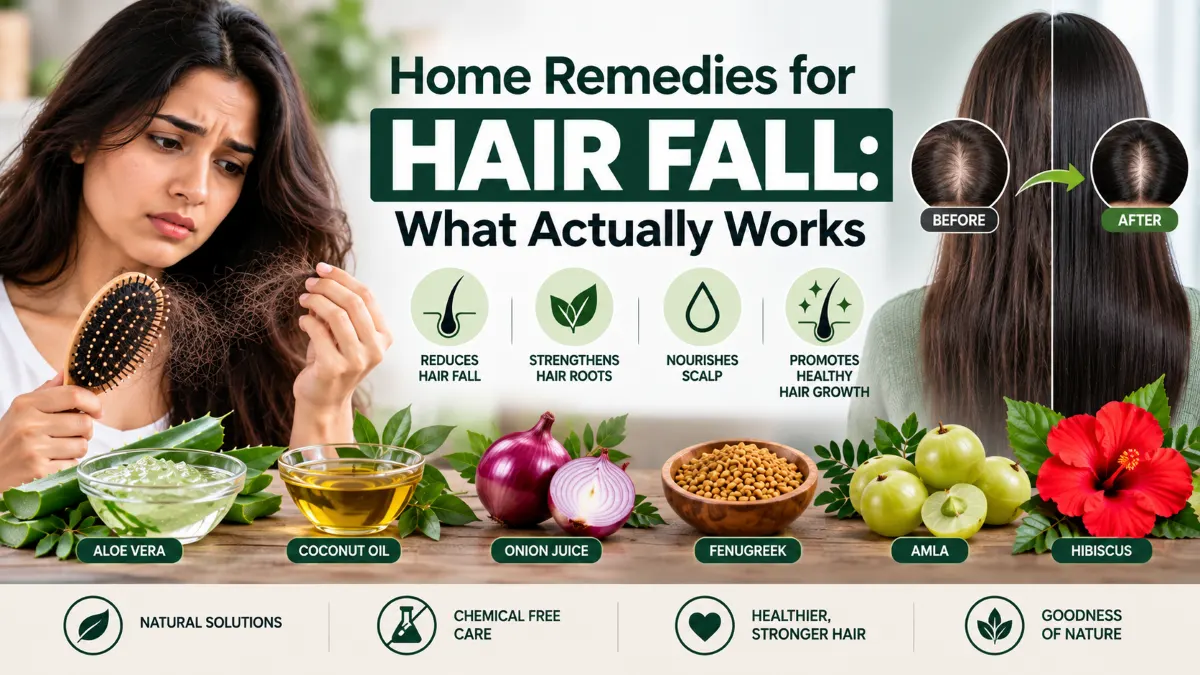
Hair shedding is a normal part of the hair-growth cycle, but noticing more hair than usual on your pillow, clothes, shower drain, or hairbrush can be concerning. Occasional shedding does not necessarily mean that you are losing your hair permanently. However, persistent or increasing hair fall may be connected to nutrition, stress, hormonal changes, scalp conditions, genetics, medications, or other underlying factors.
The good news is that improving your overall hair and scalp care can help create a healthier environment for hair growth. Some simple household practices may also reduce breakage, dryness, and scalp irritation. At the same time, it is important to separate realistic remedies from exaggerated claims. No kitchen ingredient can guarantee rapid hair regrowth, especially when hair loss is caused by a medical or genetic condition.
This guide looks at practical Hair Loss Home Remedies and explains which approaches may be useful, which popular remedies have limited evidence, and when it is better to speak with a healthcare professional.
Understanding Hair Fall Before Trying a Remedy
Hair naturally moves through different stages. During the growth phase, follicles actively produce hair. This is followed by a transition phase and then a resting phase, after which the strand eventually sheds.
Losing some hair every day is therefore expected. The concern begins when shedding becomes noticeably heavier, the scalp becomes more visible, the hairline changes, or certain areas develop thinning or bald patches.
Before choosing a remedy, it helps to consider possible Causes of Hair Fall. Common contributors include:
- Family history of pattern hair loss
- Significant physical or emotional stress
- Rapid weight loss or restrictive diets
- Low intake of protein or certain nutrients
- Hormonal changes
- Pregnancy and the postpartum period
- Thyroid disorders
- Certain medications
- Scalp infections or inflammatory conditions
- Excessive heat styling
- Frequent chemical treatments
- Tight hairstyles that repeatedly pull on the hair
- Normal age-related changes
The cause matters because a remedy that helps dry or damaged hair may not address follicle-related hair loss.
Which Home Remedies May Actually Help?
Home care is generally most useful for supporting scalp health and minimizing avoidable hair damage. It should not be considered a guaranteed treatment for every type of hair loss.
Here are some practical approaches worth considering.
1. Improve Your Diet
Hair is made primarily from a protein called keratin, so adequate nutrition is important for normal hair production. A diet that consistently lacks protein, calories, iron, zinc, or other essential nutrients can affect hair health.
Instead of relying on a single “hair growth food,” aim for a balanced eating pattern that includes:
- Eggs, fish, poultry, or other protein sources
- Beans, lentils, and other legumes
- Nuts and seeds
- Vegetables and fruits
- Whole grains
- Dairy or suitable alternatives
- Healthy sources of fats
If you suspect a nutritional deficiency, taking supplements without knowing what you actually lack may not be helpful. In some cases, excessive intake of certain supplements can even cause problems.
2. Gentle Scalp Massage
A gentle scalp massage is a simple addition to a hair fall care routine. Using your fingertips, massage the scalp for several minutes without scratching or aggressively rubbing the skin.
The purpose is primarily relaxation and gentle stimulation of the scalp rather than a promise of dramatic regrowth.
Try using light circular movements and avoid pulling on the hair fall. A massage can be performed on a dry scalp or alongside a suitable hair oil if your scalp tolerates it.
Remember that massage cannot reverse genetic pattern hair loss by itself, but it can be a relaxing part of a broader routine.
3. Coconut Oil for Hair Protection
Coconut oil is commonly used as a pre-wash hair treatment. It may help reduce dryness and improve the feel of damaged hair. One reason it is popular is that certain oils can penetrate the hair shaft and reduce some forms of protein loss.
However, this does not mean coconut oil directly stimulates new follicle growth.
For people with dry or brittle hair, applying a small amount to the lengths and ends before washing may help reduce breakage. Those with an oily scalp or acne-prone skin around the hairline may prefer to avoid heavy oil application to the scalp.
If you experience itching, redness, or irritation, stop using it.
4. Aloe Vera for Scalp Comfort
Aloe vera is often used as a soothing ingredient for the skin. Some people apply aloe-based products to the scalp when it feels dry or irritated.
Its main potential value is related to scalp comfort rather than proven treatment of significant hair loss.
If you want to try aloe vera, use a simple product with minimal added fragrance or irritating ingredients. Apply a small amount first to check how your skin reacts.
Aloe vera should not be presented as a replacement for medical treatment when hair loss is persistent or accompanied by inflammation.
5. Reduce Heat and Chemical Damage
One of the most effective ways to improve the appearance of thinning or damaged hair is to reduce unnecessary breakage.
Frequent use of:
- Straighteners
- Curling irons
- Very hot blow dryers
- Bleaching products
- Frequent chemical straightening
- Aggressive coloring treatments
can weaken the hair shaft.
This type of damage is different from hair loss originating at the follicle. Nevertheless, reducing breakage can make the hair appear fuller and healthier.
Use lower heat settings when possible, avoid repeatedly applying heat to the same section, and give chemically treated hair adequate recovery time.
6. Avoid Tight Hairstyles
Ponytails, buns, braids, extensions, and other styles can look great, but repeatedly pulling the hair tightly may put stress on the follicles.
Changing hairstyles regularly and choosing looser options can reduce unnecessary tension.
If a hairstyle causes pain, headaches, scalp tenderness, or visible pulling around the hairline, it is probably too tight.
This is particularly important around the temples and front hairline, where repeated tension may contribute to traction-related hair loss.
7. Keep the Scalp Clean
A healthy scalp provides a better environment for normal hair growth. Regular washing helps remove excess oil, sweat, styling products, dead skin, and environmental buildup.
The ideal washing frequency varies depending on your hair type and scalp. Someone with an oily scalp may need more frequent washing than someone with very dry or textured hair.
Choose a shampoo that suits your scalp and avoid excessively vigorous scrubbing.
If you have persistent dandruff, scaling, redness, burning, or itching, a specialized treatment may be more appropriate than a DIY remedy.
8. Try Rosemary Oil Carefully
Rosemary oil is one of the more frequently discussed natural ingredients in the hair-care world. Some research has investigated rosemary preparations for hair growth, but the available evidence is still limited compared with established medical treatments.
If you choose to use rosemary essential oil, never apply concentrated essential oil directly to the scalp. Essential oils should generally be appropriately diluted in a carrier oil, and a patch test can help identify sensitivity.
People with sensitive skin should be particularly cautious.
It is also important to understand that “natural” does not automatically mean safe or effective.
9. Manage Stress
Stress can affect the hair-growth cycle. A period of significant physical or emotional stress may sometimes be followed by increased shedding.
Useful stress-management habits may include:
- Regular physical activity
- Adequate sleep
- Relaxation exercises
- Breathing practices
- Spending time outdoors
- Maintaining social connections
- Taking breaks from work or screens
Stress reduction will not cure every form of hair loss, but it can support overall well-being and may be useful when stress is one of several contributing factors.
10. Handle Wet Hair Gently
Wet hair can be more vulnerable to stretching and breakage. Rather than aggressively rubbing your hair with a towel, gently squeeze out excess water.
A wide-tooth comb may be helpful for detangling, particularly for curly or textured hair. Start near the ends and gradually work upward rather than forcing a comb through knots.
Avoid repeatedly tugging through tangled sections.
These simple Natural Ways to Reduce Hair Fall are particularly useful when the problem is partly related to mechanical damage rather than follicle-level hair loss.
Natural Remedies vs. Medical Treatments
Natural care can be helpful, but it is important to understand its limits.
For example, improving nutrition can help if someone is not getting enough essential nutrients. Gentle hair care can reduce breakage. Treating an irritated scalp can improve scalp health.
But hereditary pattern hair loss, alopecia areata, certain hormonal conditions, infections, and other causes may require professional diagnosis and treatment.
That is why Natural Hair Fall Treatment should be viewed as supportive care unless a qualified healthcare professional has identified the cause and confirmed that home management is appropriate.
Read More : How to Lose Weight Naturally
When Should You Consult a Professional?
Home care methods may help with mild hair concerns, but professional advice may be needed if:
- Hair fall suddenly increases
- You notice bald patches
- The scalp becomes visible quickly
- Hair shedding continues for several months
- There is itching, pain, or scalp infection
A dermatologist can identify the underlying reason and suggest suitable treatment options.
Comparison Table: Popular Hair Fall Remedies
| Remedy | What It May Help With | Evidence/Confidence | Main Consideration |
| Balanced diet | Nutritional support | Strong for overall nutrition | Deficiencies should be evaluated rather than guessed |
| Scalp massage | Relaxation and gentle scalp care | Limited for regrowth | Use gentle pressure |
| Coconut oil | Dryness and hair-shaft protection | Moderate for hair protection | May feel heavy on oily scalps |
| Aloe vera | Scalp soothing | Limited for hair growth | Can irritate sensitive skin |
| Rosemary oil | Possible support for hair growth | Early/limited evidence | Must be diluted appropriately |
| Reducing heat | Less breakage | Strong for damage prevention | Does not treat follicle disorders |
| Loose hairstyles | Less mechanical tension | Strong for prevention of traction | Avoid repeated tight pulling |
| Regular cleansing | Scalp hygiene | Strong for general scalp care | Shampoo needs vary by individual |
| Stress management | Overall wellness | Useful when stress contributes | Not a standalone cure |
| Professional evaluation | Identifying underlying causes | Strong | Particularly important for persistent loss |
Hair Growth Remedies: What Should You Expect?
One of the biggest mistakes people make is expecting a home remedy to produce visible regrowth within a few days.
Hair grows gradually, and the biological hair cycle takes time. Even when the underlying cause of shedding is addressed, visible improvement may take weeks or months.
A realistic goal is to support healthy follicles, minimize preventable damage, maintain a healthy scalp, and address contributing factors.
Be especially cautious about products or recipes that promise:
- New hair within days
- Complete regrowth in a week
- Permanent results from one ingredient
- Guaranteed results for everyone
- Instant reversal of baldness
Such claims are usually much stronger than the available evidence.
Natural Hair Care Remedies for Different Hair Problems
Different hair concerns require different approaches. A remedy that works well for dry hair may not suit an oily scalp.
| Hair Concern | Possible Natural Approach | Additional Care |
| Dry Hair | Coconut oil, aloe vera, yogurt masks | Avoid excessive heat |
| Oily Scalp | Mild cleansing, green tea rinse | Avoid heavy oils |
| Weak Hair | Protein-rich masks, balanced diet | Reduce chemical treatments |
| Frizzy Hair | Natural oils and hydration | Use gentle combing |
| Dandruff Issues | Aloe vera, scalp-friendly care | Maintain scalp hygiene |
Simple Weekly Hair Fall Care Routine
A consistent routine can be more useful than constantly switching between different DIY recipes.
Daily
- Avoid unnecessarily tight hairstyles.
- Handle your hair gently.
- Eat balanced meals.
- Drink enough fluids according to your individual needs.
- Avoid excessive heat styling.
- Manage stress where possible.
A Few Times Per Week
- Wash your scalp according to your hair and scalp needs.
- Gently massage the scalp if comfortable.
- Use conditioner on the lengths and ends.
- Detangle carefully.
- Consider a pre-wash oil treatment if your hair tolerates it.
Monthly
Take a moment to assess whether shedding is improving, staying the same, or getting worse.
You can take photographs under similar lighting and from similar angles. This may provide a more reliable way to notice gradual changes than checking the mirror every day.
Tips to Prevent Hair Fall and Breakage
Prevention is often about reducing repeated damage rather than finding one miracle ingredient.
Some practical habits include:
- Avoid excessive heat. Use the lowest comfortable temperature.
- Do not pull aggressively. Detangle slowly, especially after washing.
- Limit harsh chemical treatments. Repeated bleaching and straightening can weaken hair.
- Protect your scalp. Excessive sun exposure can affect scalp comfort.
- Choose appropriate hair products. Consider your hair texture and scalp condition.
- Avoid extremely restrictive diets. Adequate calories and protein matter.
- Pay attention to sudden changes. Rapid shedding deserves more attention than routine daily loss.
- Do not ignore scalp symptoms. Persistent itching, scaling, pain, or redness may indicate a condition requiring treatment.
These Tips to Prevent Hair Fall are especially useful for maintaining the strength and appearance of existing hair.
Natural Hair Care Remedies That Are Worth Trying
Not every home remedy needs to be complicated.
Some of the most sensible options are actually basic hair fall care practices:
Use Conditioner
Conditioner can reduce friction and make hair easier to detangle. This can help minimize mechanical breakage.
Choose a Gentle Detangling Method
Start at the ends and gradually work toward the roots. For very tangled hair, adding conditioner or a suitable detangling product may make the process easier.
Protect Hair While Sleeping
People with long or fragile hair may find it helpful to loosely secure it at night. Smooth pillowcases may also reduce friction for some hair types.
Avoid Excessive Product Buildup
Heavy styling products can make hair feel greasy or weighed down. Regular cleansing appropriate for your scalp can help maintain cleanliness.
Protect Hair From Environmental Stress
Sun, chlorine, salt water, dry air, and pollution can affect the hair shaft. Rinsing hair after swimming and using suitable protective products can help.
These approaches focus on protecting the hair you already have rather than making unrealistic promises about creating new follicles.
When Home Care Is Not Enough
Home care may not be the right approach if hair loss is sudden, severe, or unusual for you.
Consider talking with a dermatologist or other qualified healthcare professional if you notice:
- Rapid or sudden shedding
- Bald patches
- A widening part
- Noticeable recession of the hairline
- Loss of eyebrows or eyelashes
- Scalp pain, burning, swelling, or severe itching
- Significant scaling or sores
- Hair loss after starting a medication
- Hair loss accompanied by other unexplained symptoms
- Persistent shedding that does not improve
A professional may examine the scalp, review your health and medication history, and determine whether blood tests or other evaluation is appropriate.
Finding the cause is often more important than trying increasingly complicated DIY treatments.
Can Supplements Help For Hair Fall?
Supplements can be useful when a genuine deficiency exists, but they are not automatically beneficial for everyone.
For example, taking high doses of a nutrient without needing it may provide little benefit and can sometimes create health risks.
Instead of randomly purchasing multiple “hair vitamins,” consider discussing persistent hair loss with a healthcare professional. They can help determine whether nutritional testing is appropriate.
A balanced diet should generally be the foundation of nutrition unless a clinician recommends supplementation.
Effective home remedies for hair growth: What Is the Realistic Approach?
There is no single household ingredient that works for everyone.
The most realistic approach combines several habits: good nutrition, gentle scalp care, reduced heat damage, avoidance of excessive tension, appropriate cleansing, adequate sleep, and stress management.
Some ingredients may support the condition of the hair shaft or scalp, but that is different from proving that they can reverse a specific medical form of hair loss.
Think of home care as creating favorable conditions for healthy hair rather than forcing the follicles to grow faster.
Common Mistakes to Avoid For Hair Fall
Many people unintentionally make hair fall worse while trying to fix it.
Over-Oiling
More oil does not necessarily mean more growth. Heavy oiling can make the scalp uncomfortable and difficult to cleanse.
Scrubbing the Scalp Too Hard
The scalp does not need aggressive exfoliation. Rough treatment can cause irritation.
Using Undiluted Essential Oils
Concentrated essential oils can cause skin irritation or allergic reactions. Proper dilution is important.
Changing Remedies Every Few Days
Constantly switching products makes it difficult to determine what is helping or irritating your scalp.
Ignoring the Underlying Cause
If hair loss results from a medical condition, a DIY mask may not address the actual problem.
Expecting Immediate Results
Hair biology works slowly. Give a sensible routine enough time to assess its effect.
Frequently Asked Questions
1. Can home remedies completely stop hair fall?
Home remedies may help improve scalp health and reduce breakage, but they cannot guarantee complete prevention of hair loss. The results depend on the underlying cause of hair fall.
2. What is the best home remedy for hair fall?
There is no universally best remedy. A balanced diet, gentle hair handling, appropriate scalp cleansing, reduced heat exposure, and avoiding tight hairstyles are among the most practical starting points.
3. Can diet alone stop hair fall?
Diet plays a meaningful role, especially if you have a deficiency in protein, iron, vitamin D, or zinc. However, hair loss driven by genetics (androgenetic alopecia) or a medical condition typically needs more than dietary changes alone to fully address.
4. Does cutting hair reduce hair fall?
Cutting hair does not affect hair growth from the roots. However, trimming damaged ends can make hair look healthier and reduce breakage.
5. When should I see a dermatologist?
Seek professional advice if hair loss is sudden, severe, patchy, persistent, associated with scalp symptoms, or accompanied by other unexplained changes. Early evaluation can help identify the cause and appropriate treatment.
Final Thoughts
Hair fall can have many different causes, which is why one remedy cannot work for everyone. The most useful approach is to focus on habits that protect the hair and scalp while avoiding exaggerated promises.
A nutritious diet, gentle handling, reduced heat and chemical exposure, looser hairstyles, regular scalp care, and stress management can all contribute to healthier-looking hair. Certain natural ingredients may also be reasonable additions when used safely, but they should not be treated as guaranteed cures.
If you are experiencing persistent or noticeable shedding, the most important step may be identifying why it is happening. Once the cause is understood, you can choose a more targeted approach instead of relying on trial-and-error recipes.
Ultimately, healthy hair is supported by consistent care rather than a single miracle treatment. Combining sensible Hair Fall Remedies with good nutrition, gentle styling habits, and professional guidance when necessary is a much more realistic strategy for maintaining strong, healthy hair over time.
For more trusted health information, wellness advice, and helpful resources, be sure to explore: Your Health Rights
Author


Mary Brown is a certified wellness coach and writer who focuses on nutrition, weight loss, and living a healthy life. Her main focus is creating honest product reviews and guides that assist readers in achieving fitness.