



If you have started noticing occasional forgetfulness, difficulty staying focused, or that your mind feels less sharp after a long day, you may have come across Memodyne while searching for a natural way to support cognitive health. The product is marketed as a dietary supplement designed around memory, focus, mental clarity, and everyday brain support.
But does Memodyne actually live up to the claims made around it? What ingredients does it contain, how much evidence supports those ingredients, are there potential safety concerns, and what should American consumers know before placing an order?
This detailed review looks at Memodyne from a more practical perspective. Instead of simply repeating promotional claims, we will look at the available product information, published scientific research, potential benefits, possible side effects, pricing information that has been publicly presented, and the limitations of the available evidence.
One point deserves attention before getting into the formula: online pages associated with Memodyne currently contain inconsistent ingredient information. One set of pages identifies Ginkgo biloba, St. John’s wort, Bacopa monnieri, N-acetyl L-carnitine, Huperzine A, and phosphatidylserine, while other pages associated with the product identify a different group of ingredients, including L-arginine, L-citrulline, niacin, and beta-alanine.
Because ingredient amounts are also not consistently disclosed, consumers should verify the actual label on the bottle before using the product.
What Is Memodyne?
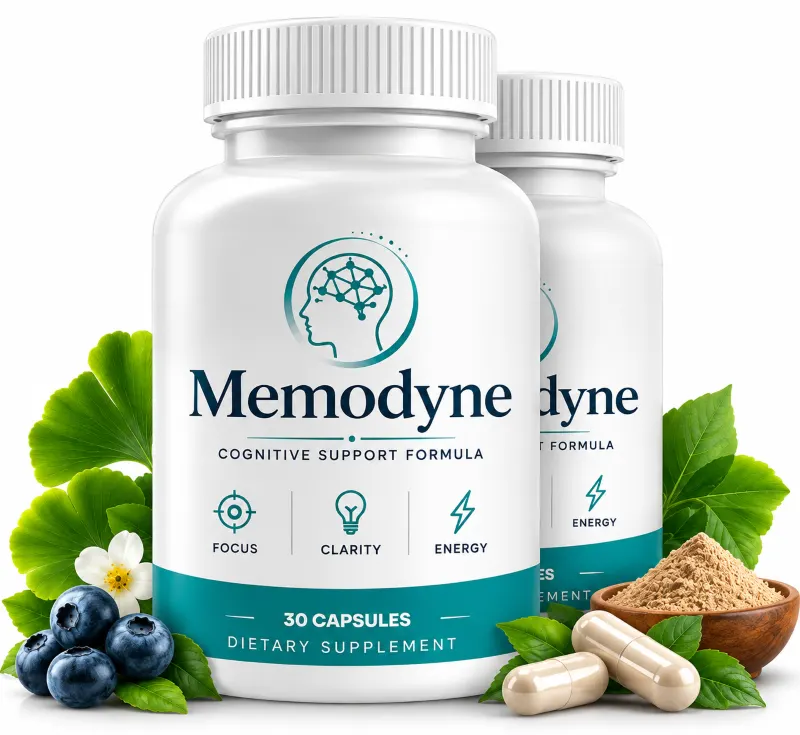
Memodyne is marketed as a capsule-based dietary supplement for adults who want nutritional support for memory, concentration, mental clarity, and general cognitive function.
The product is positioned in the growing brain-health supplement market, where consumers commonly look for formulas containing herbs, amino acids, vitamins, phospholipids, and other compounds associated with neurological function.
According to one current product description, the serving is one capsule per day and a bottle contains 30 capsules. Another product page similarly describes it as a once-daily cognitive support capsule.
That sounds straightforward, but there is an important distinction between a supplement’s marketing description and clinical evidence.
A dietary supplement does not automatically become clinically proven simply because individual ingredients have been studied. The dosage, ingredient quality, combination of ingredients, duration of use, and characteristics of the people studied all matter.
The National Center for Complementary and Integrative Health notes that many supplements are promoted for memory and brain health, but evidence varies substantially from ingredient to ingredient. NCCIH also cautions that evidence for preventing dementia or Alzheimer’s disease with dietary supplements is not conclusive.
So, when evaluating Memodyne, it makes more sense to ask what evidence exists for its individual ingredients and whether the product provides enough information to determine whether those studied doses are actually present.

Memodyne Ingredients: What Is Actually Listed?
The ingredient question is particularly important with this product because different online pages currently provide different formulations.
One version of the product information lists six active ingredients:
- Ginkgo Biloba
- Bacopa Monnieri
- Phosphatidylserine
- Huperzine-A
- N-Acetyl L-Carnitine
- St. John’s Wort
Another product page lists L-Arginine, L-Arginine AKG, L-Citrulline HCL, L-Citrulline Malate, Niacin, and Beta-Alanine.
This is a significant difference rather than a minor labeling variation. Anyone considering the product should therefore verify the ingredient panel printed on the bottle.
Bacopa Monnieri
Bacopa Monnieri is a botanical ingredient that has been studied for memory and cognitive performance. Some clinical trials have investigated standardized Bacopa extracts over several weeks rather than expecting an immediate effect.
The research is interesting, but results depend on the extract, dose, duration, and population being studied. A systematic review of cognitive supplement ingredients identified Bacopa among the ingredients with published human research, while also noting limitations in the overall evidence base.
Ginkgo Biloba
Ginkgo Biloba is another well-known botanical frequently included in products targeting cognitive health. It has been extensively studied, but research has not established that every Ginkgo supplement or formulation produces meaningful improvements in memory.
An earlier systematic review of over-the-counter supplements found that evidence concerning Ginkgo and several other supplements was insufficient or low-strength for preventing cognitive decline.
Phosphatidylserine
Phosphatidylserine is a naturally occurring phospholipid found in cell membranes, including those in the brain. It has been investigated for cognitive function and age-related memory concerns.
However, the presence of an ingredient in a supplement does not automatically mean the finished product has been clinically tested. This distinction is important when evaluating multi-ingredient formulas.
Huperzine-A
Huperzine-A is a compound derived from Huperzia serrata that has attracted scientific interest because of its effects on acetylcholinesterase. This makes it more pharmacologically active than many general nutritional ingredients.
Because of that activity, consumers should not assume that “natural” automatically means risk-free. Anyone taking medication or managing a medical condition should discuss the ingredient with a healthcare professional.
N-Acetyl L-Carnitine
N-Acetyl L-Carnitine is a form of carnitine that has been studied in relation to neurological and cognitive conditions. However, evidence for cognitive benefits varies by population and clinical situation.
St. John’s Wort
St. John’s Wort deserves special attention if it is present in the version of the formula being purchased. It is primarily associated with mood-related uses rather than being a conventional memory ingredient.
More importantly, St. John’s Wort can interact with numerous medicines by affecting drug-metabolizing enzymes and transporters. It can also interact with certain antidepressants and other medications. Therefore, people taking prescription medicines should consult a doctor or pharmacist before using a product containing it.
Potential Benefits of Memodyne
The potential benefits depend heavily on which formulation is actually supplied.
The product is marketed around several areas of cognitive wellness, including memory, concentration, mental clarity, and general brain support. These are reasonable areas for consumers to investigate, but marketing claims should not be confused with proven clinical outcomes.
People considering a cognitive health supplement may be looking for support with everyday tasks such as remembering appointments, staying focused during work, maintaining concentration while studying, or dealing with occasional forgetfulness.
Potentially relevant areas include:
Memory support: Certain ingredients such as Bacopa have been investigated in human studies involving memory.
Focus and concentration: Some ingredients included in cognitive formulas have mechanisms that may influence neurological signaling, although that does not establish that the finished product improves concentration.
General brain wellness: Adequate nutrition, physical activity, sleep, cardiovascular health, and management of medical conditions are all important parts of maintaining cognitive health.
Longer-term cognitive health: Consumers should be particularly cautious about products that promise prevention or treatment of dementia. The National Institute on Aging recommends discussing persistent memory problems with a healthcare professional rather than relying on unproven memory-enhancement products.
Memodyne Side Effects and Safety
When discussing Memodyne side effects, the first issue is that there does not appear to be a large published clinical trial specifically testing the finished product and establishing its complete safety profile.
Potential reactions will therefore depend on the actual ingredients, their quantities, and the individual taking them.
People may experience digestive discomfort, headache, dizziness, or other ingredient-specific reactions with some dietary supplements. More importantly, certain ingredients can interact with prescription medicines.
If the version purchased contains St. John’s Wort, interaction concerns become particularly important. It can affect the effectiveness of several medicines, including some hormonal contraceptives, anticoagulants, immunosuppressants, and other prescription drugs.
Anyone who is pregnant or breastfeeding, under 18, taking prescription medication, or managing a medical condition should obtain professional advice before starting a new supplement.
Also remember that persistent or worsening memory loss should not simply be treated with supplements. The National Institute on Aging notes that memory problems can have multiple causes and recommends medical evaluation when problems persist.
Memodyne Pros and Cons
| Pros | Cons |
| Convenient capsule format | Online ingredient information is inconsistent |
| Marketed for everyday cognitive support | Individual ingredient amounts are not consistently disclosed |
| Several listed ingredients have been studied independently | Product-specific clinical evidence is limited |
| Once-daily format is simple | Some ingredients may interact with medications |
| Some ingredients have human research behind them | Marketing claims should not be treated as medical evidence |
| Available for U.S. consumers through online sales pages | Consumers should verify the physical label before use |
How to Use Memodyne
Current product pages generally describe a once-daily capsule routine, although consumers should follow the instructions printed on the actual product they receive rather than relying exclusively on a webpage.
Do not exceed the manufacturer’s recommended serving.
More is not necessarily better. Increasing the amount of a supplement can increase the likelihood of side effects or interactions without providing additional benefits.
It is also sensible to avoid stacking multiple products with overlapping ingredients unless a healthcare professional has reviewed the combination.
Memodyne Pricing and Packages
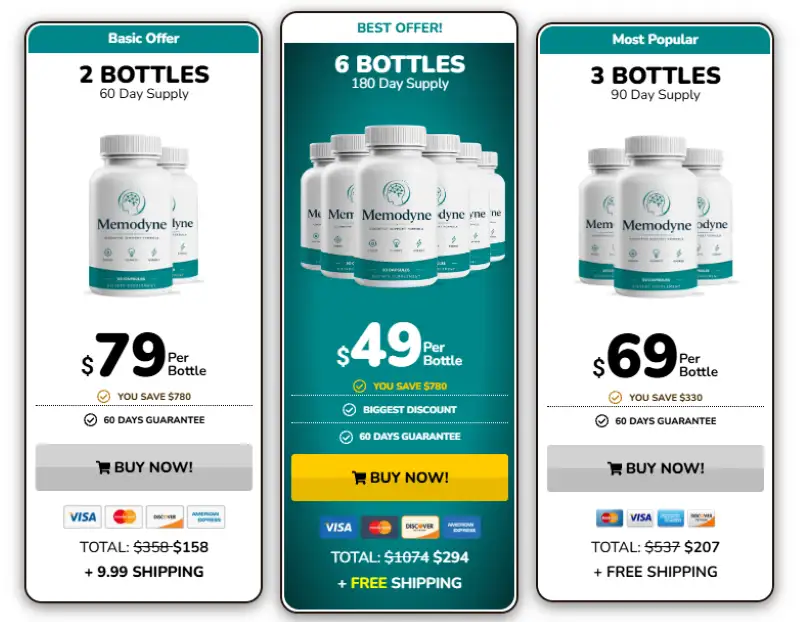
The online sales pages advertise different package options, including multi-bottle bundles. One current product page states that packages can include two, three, or six bottles and mentions a 60-day money-back guarantee.
Because supplement pricing and promotional discounts can change, buyers should verify the final price, shipping charges, refund terms, and package contents at checkout.
Search results also show different Memodyne-branded domains and product descriptions, so consumers should be especially careful when checking the Memodyne pricing and packages and should verify that the website, product label, payment page, and company information all correspond to the same product.
For the same reason, verify the Memodyne official website carefully before entering payment information. Do not assume that every website using the Memodyne name represents the same formulation.
Memodyne Results: What Should You Expect?
This is where expectations matter.
There is currently not enough high-quality, product-specific clinical evidence to say that a particular percentage of users will experience improved memory or concentration after a specific number of days.
Individual results can vary because memory and concentration are influenced by age, sleep, stress, diet, exercise, medical conditions, medication use, and baseline cognitive function.
Someone whose poor concentration is primarily caused by sleep deprivation may respond very differently from someone whose symptoms are related to a medical condition.
A responsible approach is to look for measurable changes rather than relying entirely on testimonials.
For example, a person could track whether they are completing daily tasks more efficiently, remembering routine information more consistently, or maintaining attention during normal activities.
If symptoms are new, worsening, or interfering with everyday life, a medical evaluation is more appropriate than simply increasing supplement use.
A Hypothetical USA User Case Study
Consider a hypothetical 52-year-old office worker in Texas who has noticed that long workdays leave him distracted and occasionally forgetful.
He sleeps around six hours on weekdays, drinks several cups of coffee, exercises inconsistently, and spends most of the workday sitting.
He finds an advertisement for Memodyne and decides to investigate it.
Rather than immediately purchasing several bottles, he first reviews the label, checks the ingredient list, and speaks with his pharmacist because he takes prescription medication.
The pharmacist points out that the exact ingredient list matters and that some herbal ingredients can interact with medicines. The consumer then focuses on improving sleep, adding regular walking, improving his diet, and tracking his concentration.
After several weeks, he reports feeling more alert during the afternoon. However, he cannot confidently attribute that change to the supplement because he also increased his sleep and physical activity.
This example illustrates an important principle: real-world outcomes often involve multiple variables.
It would be misleading to say that a single supplement caused every positive change.
Memodyne vs. a Basic Single-Ingredient Approach
Consumers often compare a multi-ingredient supplement with individual ingredients.
| Factor | Memodyne | Single-ingredient supplement |
| Formula | Multi-ingredient | Usually one primary active |
| Ingredient research | Research generally relates to individual ingredients | Easier to identify |
| Dose transparency | Public information is inconsistent | Often easier to verify |
| Interaction assessment | More complicated | Usually simpler |
| Convenience | One product | May require separate products |
| Product-specific evidence | Limited based on currently available information | Depends on the ingredient |
| Personalization | Less flexible | Easier to adjust |
The major advantage of a multi-ingredient formula is convenience. The major challenge is determining which ingredients are present, at what doses, and whether the combination has been clinically tested.
Is Memodyne Legit?
The more useful question is not simply whether Memodyne is “legit” or “fake.”
The available evidence suggests that Memodyne is being marketed as a real dietary supplement, but there are information-quality issues that consumers should investigate before buying.
The biggest issue identified during this review is the inconsistency between online ingredient descriptions. One set of pages lists six cognitive-oriented ingredients, while another lists a different six-ingredient formula.
That does not by itself establish that the product is fraudulent. It does, however, make label verification particularly important.
The FDA also explains that dietary supplements are not FDA-approved for safety and effectiveness before marketing in the manner drugs are.
Therefore, consumers should not interpret an “FDA-registered facility” statement as meaning the individual supplement has been FDA-approved.
How to Order Memodyne Safely
If you decide to Order Memodyne, take a few minutes to verify the product before purchasing.
First, compare the ingredient panel on the sales page with the label shown on the bottle. Second, check whether individual ingredient quantities are disclosed. Third, review the return policy and the final checkout price. Finally, if you take medication, show the ingredient list to your doctor or pharmacist.
This is particularly important because the currently available online Memodyne pages contain inconsistent ingredient descriptions.
What Scientific Research Says Overall
There is useful scientific literature for evaluating the individual ingredients and the broader category.
A 2021 systematic review published in the Journal of Alternative and Complementary Medicine evaluated dietary supplement ingredients marketed for cognitive performance. The researchers concluded that the overall level of certainty remained limited and that uncertainty about supplement contents made it difficult to make firm recommendations.
An Annals of Internal Medicine systematic review examined over-the-counter supplements for preventing or delaying cognitive decline and found insufficient or low-strength evidence for several commonly marketed supplements, including Ginkgo and various multi-ingredient products.
More recently, a 2026 systematic review and network meta-analysis examined dietary supplements in people with mild cognitive impairment or Alzheimer’s disease and evaluated evidence from 29 trials involving approximately 2,000 participants. The findings illustrate that the evidence surrounding supplements can differ considerably by ingredient, population, and outcome measured.
These studies do not prove that Memodyne itself works or does not work. Instead, they provide context for understanding why ingredient-level evidence should not be treated as proof of a commercial product’s effectiveness.
Frequently Asked Questions
1. What is Memodyne used for?
Memodyne is marketed as a dietary supplement for memory, focus, mental clarity, and general cognitive support. It should not be considered a treatment for dementia, Alzheimer’s disease, or another diagnosed neurological condition.
2. Does Memodyne really improve memory?
There is not enough product-specific clinical evidence to guarantee a particular memory improvement. Some ingredients associated with the product have been studied individually, but that evidence cannot automatically be transferred to the finished product.
3. How long does Memodyne take to work?
There is no scientifically established timeline for when the finished product should produce noticeable cognitive effects. Results can vary depending on the individual and the underlying reason for memory or concentration problems.
4. How much does Memodyne cost?
The advertised price and package options can change. Current online pages show different package and guarantee information, so consumers should verify the final price, shipping, and refund terms on the seller’s checkout page before purchasing.
5. Can Memodyne cause side effects?
Potential side effects depend on the exact formulation. Ingredients such as ginkgo and St. John’s wort can cause adverse effects or interact with medications. Always check the current label and discuss potential interactions with a healthcare professional.
Final Thoughts on Memodyne
Memodyne sits in a crowded market of products designed to support memory, concentration, and everyday cognitive performance.
There are scientifically interesting ingredients associated with some versions of the formula. Bacopa has human memory research, Huperzine A has been investigated for cognitive impairment, phosphatidylserine has been studied in older adults, and ginkgo is one of the more extensively researched botanical ingredients in this category.
At the same time, there are reasons to approach the product carefully.
The most important concern is the inconsistent ingredient information currently appearing across different Memodyne-related pages. Some sources list one six-ingredient formula, while others describe a substantially different combination.
That makes the actual bottle label more important than any online advertisement.
The scientific evidence also does not justify treating Memodyne as a cure for memory disorders or a replacement for medical care. Supplements may have a role in an overall wellness strategy, but healthy aging and cognitive health involve many factors, including sleep, exercise, nutrition, cardiovascular health, stress management, and appropriate medical care.
If you are considering Memodyne, verify the exact formula, check ingredient amounts, review medication interactions, understand the refund policy, and keep expectations realistic.
Most importantly, persistent or worsening memory problems deserve proper medical evaluation rather than simply being treated with an over-the-counter supplement.
Scientific and Reference Sources
The following resources were used to evaluate the scientific and regulatory information discussed in this article:
- FDA — Dietary Supplements: FDA explains how dietary supplements are regulated and why consumers should understand that supplements are not pre-approved for safety and effectiveness like drugs.
- NCCIH — Cognitive Health Supplements: NCCIH summarizes the evidence and limitations surrounding supplements promoted for cognitive function.
- NCCIH — St. John’s Wort: Provides detailed information about potential interactions and safety considerations.
- NCCIH — Ginkgo: Provides information on ginkgo’s evidence, common side effects, and potential medication interactions.
- PubMed — Bacopa Research: Human randomized research examining Bacopa and memory performance.
- PubMed — Huperzine A: Systematic reviews and meta-analyses examining Huperzine A and cognitive outcomes.
Medical disclaimer: This article is for educational and informational purposes only. It is not intended to diagnose, treat, cure, or prevent any disease. Individual results may vary. Anyone with a medical condition or anyone taking prescription or over-the-counter medication should consult a qualified healthcare professional before starting a dietary supplement.
Author


Your Health Rights is a U.S.-based health and wellness platform dedicated to empowering readers with clear, research-backed content across Men’s Health, Women’s Health, Weight Loss, Health Supplements, and Immunity & General Wellness.


