



MindSave is marketed as a once-daily cognitive wellness capsule designed to support memory, focus, attention, and everyday mental performance. But does the formula actually have enough evidence behind it, and is it worth the asking price?
In this detailed MindSave Review 2026, we look at the advertised formula, ingredient evidence, pricing, buying options, potential benefits, limitations, safety considerations, and how it compares with a more general approach to cognitive wellness.
Quick answer: MindSave may be an interesting option for adults looking for nutritional support for memory and focus, particularly because its advertised formula includes ingredients such as Bacopa monnieri, L-tyrosine, alpha-GPC, phosphatidylserine, and huperzine A. However, there is an important limitation: the product’s online sales information currently presents two different ingredient lists, and the finished product itself does not appear to have a published clinical trial. Therefore, buyers should verify the Supplement Facts panel on the bottle before purchasing or using it.
What Is MindSave?
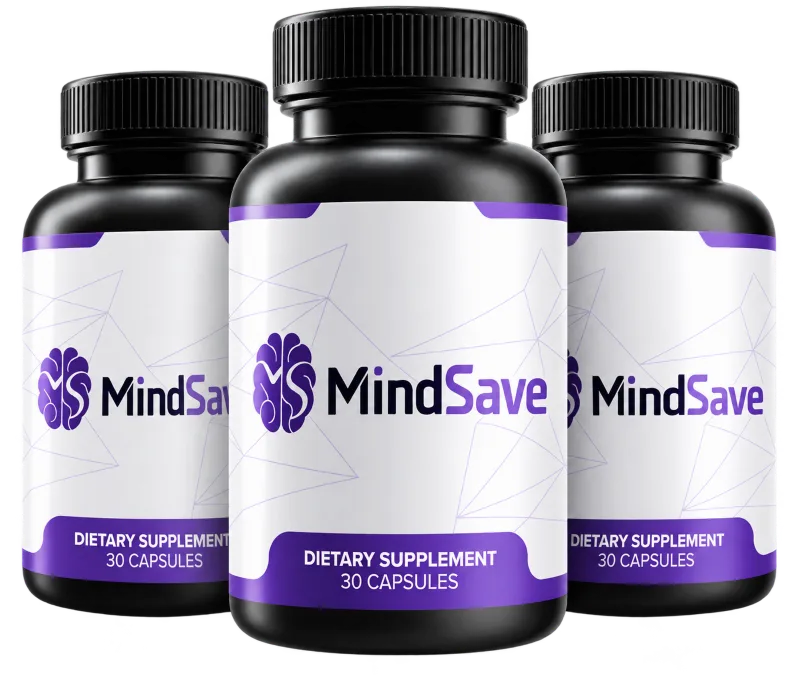
MindSave is a dietary supplement sold in capsule form and positioned around cognitive wellness. According to the seller’s website, the routine is one capsule per day, with a 30-capsule bottle described as a 30-day supply. The product is intended for adults aged 18 and older.
The concept behind MindSave is relatively straightforward: combine several nutrients and botanical compounds that have been studied individually for areas such as memory, attention, neurotransmitter activity, and cognitive performance.
The advertised formula includes:
- Niacinamide
- Vitamin B6
- GABA
- L-tyrosine
- Bacopa monnieri
- Alpha-GPC
- Phosphatidylserine
- Huperzine A
However, there is a significant point consumers should understand before relying on the ingredient claims.
The current sales information lists those eight ingredients without amounts, while a separate printed-label image shown online appears to describe a different formula containing ingredients such as caffeine from green coffee, theacrine, and theobromine. Because these two presentations do not agree, it would be inappropriate to assume that every ingredient shown online is definitely present in the same final formulation.
That discrepancy is one of the most important findings in this MindSave Review.

MindSave Review 2026: Quick Facts
| Feature | Details |
| Product type | Dietary supplement |
| Form | Capsules |
| Suggested routine | One capsule daily |
| Bottle | 30 capsules |
| Intended users | Adults 18+ |
| Main purpose | Memory, focus and cognitive wellness |
| Published finished-product clinical trial | Not identified |
| Guarantee | 60 days according to seller |
| Subscription | Seller states no subscription |
| Lowest advertised bottle price | $49 with six-bottle purchase |
| Highest advertised bottle price | $79 with two-bottle purchase |
| Buying Guide | Official Website |
| FDA approval | No — dietary supplements are not FDA-approved products |
The FDA itself explains that dietary supplements are not approved for safety and effectiveness before being marketed in the same way prescription medicines are. Manufacturers are responsible for ensuring their products are safe and their claims comply with applicable requirements.
How Does MindSave Work?
The theory behind MindSave is based on combining several different types of compounds rather than depending on one ingredient.
Some ingredients are nutritional compounds, while others have been investigated for their possible effects on neurotransmitter systems or cognitive performance.
For example, Bacopa monnieri has been studied in randomized human trials involving memory. A systematic review found that the available trials were generally conducted over approximately 12 weeks, with some evidence for improved memory free recall but less consistent evidence for other cognitive domains.
L-tyrosine has a different rationale. It is a precursor involved in catecholamine neurotransmitter production. A review of research in healthy adults found that it may help cognitive performance during stressful conditions, although the researchers described the overall evidence as insufficient for confident recommendations.
Huperzine A has also been investigated in cognitive research. Reviews have reported potentially beneficial effects in certain populations, but concerns remain regarding study quality, heterogeneity, and the need for better-quality clinical trials.
So, the underlying concept is scientifically plausible in some respects. That does not, however, mean the finished product has been proven to improve memory or prevent cognitive decline.
Those are two very different claims.
MindSave Ingredients Explained
One of the most important parts of this MindSave Review 2026 is understanding what the individual ingredients may actually contribute.
Bacopa Monnieri
Bacopa monnieri, sometimes called Brahmi, is probably the most interesting botanical in the advertised formula.
A systematic review of randomized controlled human trials found six qualifying studies involving adults without dementia or significant cognitive impairment. The studies generally lasted 12 weeks, and the review found some evidence of improved memory free recall.
A later meta-analysis involving nine studies and 518 participants also reported potential improvements in certain cognitive measures, although the researchers emphasized the need for well-designed trials using standardized preparations.
More recently, a 2026 network meta-analysis found Bacopa promising for certain cognitive outcomes in healthy older adults, particularly executive-function measures, while noting that further research on dosage, long-term safety, and mechanisms is needed.
Bottom line: Bacopa has meaningful research behind it, but the exact extract, dose, and standardization matter.
L-Tyrosine
L-tyrosine is an amino acid involved in the production of catecholamine neurotransmitters.
Research has particularly examined its potential during periods of psychological or environmental stress. A review of 14 controlled studies found a possible cognitive benefit under stressful conditions but concluded that the evidence was not strong enough for a confident recommendation.
This means it should not be presented as a guaranteed memory enhancer.
Alpha-GPC
Alpha-GPC is a source of choline and has been investigated because choline is involved in acetylcholine production, a neurotransmitter important for memory and learning.
A systematic review and meta-analysis found evidence of cognitive benefits in certain neurological populations, particularly when alpha-GPC was used alongside other treatments.
However, the Alzheimer’s Drug Discovery Foundation notes that there is insufficient evidence demonstrating that alpha-GPC improves cognition in healthy individuals.
Phosphatidylserine
Phosphatidylserine is a phospholipid naturally found in cell membranes and has attracted interest in research involving cognitive function.
The evidence is not uniform. A 2026 systematic review examining phosphatidylserine-containing interventions in people with mental disorders found heterogeneous results and concluded that the evidence did not currently support these compounds as established cognitive enhancers for those conditions.
Huperzine A
Huperzine A is a compound traditionally associated with Huperzia serrata. It can inhibit acetylcholinesterase, an enzyme involved in the breakdown of acetylcholine.
That mechanism explains why it has attracted attention in cognitive research.
However, the evidence needs to be interpreted carefully. An overview of systematic reviews found potentially beneficial effects in Alzheimer’s disease but also emphasized heterogeneity and limitations in the underlying research.
It is therefore not accurate to describe huperzine A as a proven treatment for dementia or Alzheimer’s disease.
Vitamin B6 and Niacinamide
Vitamin B6 and niacinamide are established nutrients involved in normal metabolic processes.
Their inclusion does not automatically make a supplement a powerful nootropic. Their relevance depends on dietary intake, dose, individual nutritional status, and the overall formulation.
GABA
GABA is an inhibitory neurotransmitter in the central nervous system. Oral GABA supplementation is a more complicated subject because the relationship between supplemental GABA and effects within the brain is not straightforward.
Consequently, consumers should avoid interpreting its presence on a label as proof of a direct calming or cognitive effect.
An Important Issue With the Formula
This is where the MindSave review becomes more critical.
The seller’s main product information lists eight ingredients but does not provide amounts for them. Meanwhile, another label presentation on the website shows a different formulation that includes caffeine from green coffee together with theacrine and theobromine. That creates a reasonable question:
Which formula is actually inside the bottle?
Until the manufacturer provides a single, current Supplement Facts panel that clearly identifies the ingredients and quantities, consumers should not assume that every ingredient listed across the website belongs to the same final product.
For someone sensitive to stimulants, this is especially relevant if caffeine-containing ingredients appear on the physical label.
The best approach is simple: check the actual bottle and Supplement Facts panel before taking the first capsule.
Potential MindSave Benefits
Based on the product positioning and the available ingredient research, the potential benefits can be summarized as follows.
1. Memory support
The strongest rationale comes from ingredients such as Bacopa and phosphatidylserine. Some studies have reported improvements in selected memory measures, although results are not consistent across all trials.
2. Focus and concentration
Tyrosine and choline-related ingredients provide a theoretical basis for supporting mental performance. However, individual responses can vary significantly.
3. Everyday cognitive wellness
A formula combining vitamins, amino acids, plant compounds and phospholipids may appeal to people who want broader nutritional support rather than a single-ingredient product.
4. Convenient daily format
The capsule format is simple. The seller recommends one capsule per day, meaning users don’t need to measure powder or prepare a drink.
MindSave Price: How Much Does It Cost?
According to the seller’s pricing page, the currently advertised packages are:
| Package | Price per bottle | Total | Approx. daily cost* |
| 2 bottles | $79 | $158 | $2.63 |
| 3 bottles | $69 | $207 | $2.30 |
| 6 bottles | $49 | $294 | $1.63 |
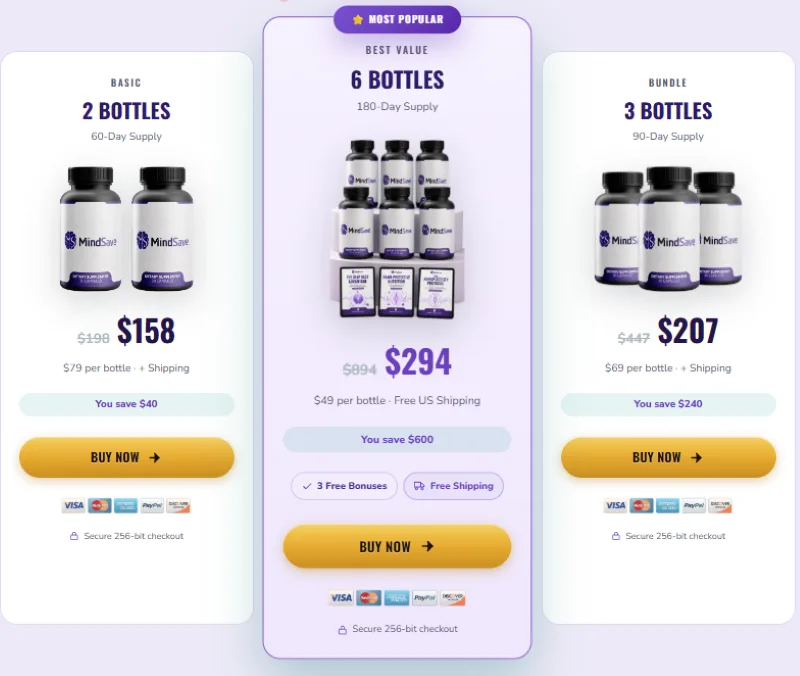
*Based on one capsule per day and excluding applicable shipping.
The seller states that the two- and three-bottle packages have shipping added at checkout, while the six-bottle package includes free U.S. shipping. It also states that purchases are one-time payments rather than subscriptions.
The company advertises a 60-day money-back guarantee, including acceptance of empty bottles according to its published policy. Consumers should nevertheless read the current refund terms carefully before ordering.
Is MindSave Legit?
The answer requires some nuance.
There is a functioning seller website, published product information, pricing, and a stated refund policy. The seller also provides a disclaimer acknowledging that the product is a dietary supplement rather than an FDA-approved drug.
So it would be inaccurate to automatically call it a scam simply because it is a supplement.
At the same time, consumers should not interpret “legit” as “clinically proven.”
The seller itself states that the finished product has not been the subject of a published clinical trial. It also acknowledges that two ingredient lists do not agree.
Therefore, my assessment is:
MindSave appears to be a commercially sold dietary supplement, but the evidence for the finished product is limited, and the conflicting formula information is a legitimate reason for caution.
That is a more useful conclusion than simply saying “scam” or “100% legit.”
Pros and Cons of MindSave
| Pros | Cons |
| Convenient once-daily capsule | Finished-product clinical evidence is limited |
| Includes ingredients with published research | Online ingredient information is inconsistent |
| Bacopa has human cognitive research | Individual ingredient evidence doesn’t prove the finished formula works |
| Seller advertises a 60-day guarantee | Ingredient amounts are not clearly provided in the main ingredient list |
| Multiple package options | Larger packages require a larger upfront payment |
| No subscription according to seller | Shipping costs may apply to smaller packages |
| Designed for general cognitive wellness | Not a treatment for dementia or Alzheimer’s disease |
MindSave User Experience: What Can USA Users Expect?
Consider “Michael,” a 52-year-old office worker in Texas. He spends most of his workday switching between spreadsheets, emails, video meetings, and project documents. He occasionally feels mentally tired by late afternoon and finds that he sometimes needs more time to recall names or details.
Instead of treating those symptoms as evidence of a medical condition, Michael first looks at his lifestyle.
He discovers that he sleeps around six hours on weekdays, exercises inconsistently, drinks several caffeinated beverages late in the day, and frequently skips breakfast.
He decides that a supplement alone is unlikely to solve everything.
Before trying MindSave, he checks the label, reviews his medications with his pharmacist, and confirms the actual Supplement Facts panel on the bottle.
During the next several weeks, he also improves his sleep schedule, exercises regularly, eats more balanced meals, and keeps a simple journal tracking focus and memory.
After several weeks, he reports that his afternoon routine feels easier.
But can he conclude that the capsule caused the improvement?
No.
His sleep, exercise, diet, reduced stress, and supplementation all changed at approximately the same time.
This is exactly why anecdotal experiences should not be treated as clinical evidence.
A realistic USA consumer should think of a product like this as a possible component of a broader cognitive-wellness routine, not as a guaranteed shortcut.
Where to Buy MindSave
If you decide to purchase, the safest approach is to use the seller’s current official sales channel rather than an unknown marketplace listing.
The official website currently identifies itself as the direct ordering source and provides the product information, package options, payment process, and refund information.
Before completing an order, check:
- The current Supplement Facts panel.
- Ingredient quantities.
- Shipping charges.
- Refund terms.
- Whether the product being ordered matches the advertised formula.
- The seller’s contact information.
This is particularly important because of the ingredient-list inconsistency discussed earlier.
How Long Could MindSave Take to Work?
There is no scientifically established timeline for the finished product because a published clinical trial on the complete formulation has not been identified.
The seller suggests that consumers may need several months to assess the experience, while the research on Bacopa has often involved approximately 12-week intervention periods.
Therefore, expecting a dramatic change after one or two capsules would not be scientifically reasonable.
If someone experiences a sudden or unusual reaction after taking a supplement, however, they should stop and seek appropriate medical advice rather than simply continuing to “wait for it to work.”
MindSave Reviews: What Should Buyers Look For?
When reading MindSave Reviews, look beyond star ratings.
A useful review should answer:
- Was the reviewer actually using the product?
- How long did they use it?
- What was their reason for taking it?
- Did they report measurable changes?
- Were other lifestyle factors changed?
- Was the exact formula identified?
- Are the reviews independently verified?
- Are negative experiences represented?
The seller’s website currently displays customer reviews and states that individual results vary. It also acknowledges that the testimonials represent individual experiences rather than guaranteed outcomes.
That disclaimer is important.
No responsible review should promise that every buyer will experience improved memory, concentration, or mental clarity.
MindSave and FDA Approval: What You Need to Know
One common misunderstanding is the phrase “FDA approved supplement.”
MindSave is not an FDA-approved drug.
More importantly, this is not unusual. The FDA states that it does not approve dietary supplements for safety and effectiveness before they reach the market. Instead, supplement companies carry responsibility for complying with applicable safety, manufacturing, and labeling requirements, while FDA oversight includes post-market monitoring and enforcement.
Therefore, “not FDA approved” does not automatically mean a supplement is fraudulent.
But it also should not be interpreted as evidence that a product has been clinically proven.
Those are separate issues.
Frequently Asked Questions
1. What is MindSave?
MindSave is a once-daily dietary supplement marketed to support memory, focus, concentration, and everyday cognitive performance.
2. What are the main MindSave ingredients?
The seller’s main product information names niacinamide, vitamin B6, GABA, L-Tyrosine, Bacopa monnieri, Alpha GPC, phosphatidylserine, and huperzine A. However, another published label describes a different formula, so the current bottle should be checked before use.
3. How much does MindSave cost?
Current advertised packages are $158 for two bottles, $207 for three bottles, and $294 for six bottles. The effective per-bottle price decreases with larger packages.
4. Is MindSave safe?
Safety depends on the individual, the actual formula, dosage, medications, and health status. Anyone taking prescription medication or managing a medical condition should consult a healthcare professional before use.
5. Does MindSave have a money-back guarantee?
The seller currently advertises a 60-day money-back guarantee. Consumers should review the current refund conditions before ordering.
Final MindSave Review 2026: Is It Worth Considering?
After reviewing the available product information and scientific literature, MindSave falls into the category of a potentially interesting but evidence-limited cognitive wellness supplement.
Its advertised formula contains several ingredients with scientific research behind them, especially Bacopa monnieri. Research on Bacopa provides some support for specific memory outcomes, although the evidence depends on standardized preparations and appropriate dosing.
The problem is that ingredient-level research cannot establish the effectiveness of the finished product.
The biggest concern in this review is therefore not simply the price. It is formulation transparency.
The seller currently presents different ingredient information in different places. Until that discrepancy is resolved with a clear, current Supplement Facts panel, buyers should verify the actual bottle before use.
So, is MindSave legit?
It appears to be a commercially marketed dietary supplement with an active sales website and a stated refund policy. But it should not be confused with a clinically proven treatment for memory disorders or neurodegenerative disease.
For a healthy adult interested in general cognitive wellness, it may be worth researching further. For someone experiencing meaningful or progressive memory problems, a medical evaluation is much more important than purchasing a supplement.
Scientific Resources & References
For readers who want to investigate the science independently, these are useful resources:
- FDA — Dietary Supplements: FDA Dietary Supplement Information
- PubMed — Bacopa systematic review: Bacopa Monnieri Cognitive Research
- PubMed — Bacopa meta-analysis: Bacopa Cognitive Meta-analysis
- PubMed — L-Tyrosine and cognitive performance: Tyrosine Evidence Review
Bottom Line
MindSave has an appealing concept and includes several ingredients that have been studied individually for cognitive health. Bacopa, in particular, has a reasonably interesting body of human research. But the finished product has not been established through a published clinical trial, and the conflicting ingredient information is something prospective buyers should take seriously.
If you are considering MindSave, verify the current label, check the ingredient amounts, review possible medication interactions with a healthcare professional, and approach the product as a supplement for general wellness—not as a treatment for memory disease.
For healthy adults, the strongest foundation for cognitive health remains adequate sleep, regular physical activity, a nutritious diet, social engagement, mental stimulation, and appropriate management of cardiovascular risk factors. A supplement can potentially complement those habits, but it should not replace them.
Disclaimer
This article is for informational purposes only and is not intended as medical advice. MindSave is a dietary supplement and is not intended to diagnose, treat, cure, or prevent any disease. Individual results may vary. Consult your doctor before using any supplement, especially if you take medication or have a medical condition.
Author


Your Health Rights is a U.S.-based health and wellness platform dedicated to empowering readers with clear, research-backed content across Men’s Health, Women’s Health, Weight Loss, Health Supplements, and Immunity & General Wellness.


